Drywall Contractor Marketing: How to Get More Drywall Jobs
If you're a drywall contractor in 2026, your biggest business challenge probably isn't your craft — it's your pipeline. The drywall trade is highly competitive, margins are tight, and most contractors are still depending on word-of-mouth referrals and relationships with a handful of GCs. That's a fragile business model.
The drywall contractors who are winning today are the ones who've built consistent online lead generation systems. They rank on Google when homeowners search "drywall repair near me." They have 150+ Google reviews while their competitors have 12. They run Google Local Services Ads and pay only when a genuine lead calls. And they show dramatic before/after photos on social media that generate direct message inquiries without spending a dollar on ads.
This guide shows you exactly how to build that system for your drywall business — step by step.
Why Drywall Marketing Is Different
Drywall marketing has specific nuances that generic marketing advice misses. Here's what makes the drywall trade unique:
1. Split customer base. Your customers are either homeowners (retail) or contractors and builders (B2B). Your marketing strategy needs to address both — because the channels, messaging, and pricing conversation are completely different.
2. Emergency demand. Water damage, holes in walls, and renovation damage create urgent, high-intent searches. "Drywall repair after water damage" and "patch hole in drywall same day" are searches from people who need help now. Fast response time and emergency availability can win you premium rates.
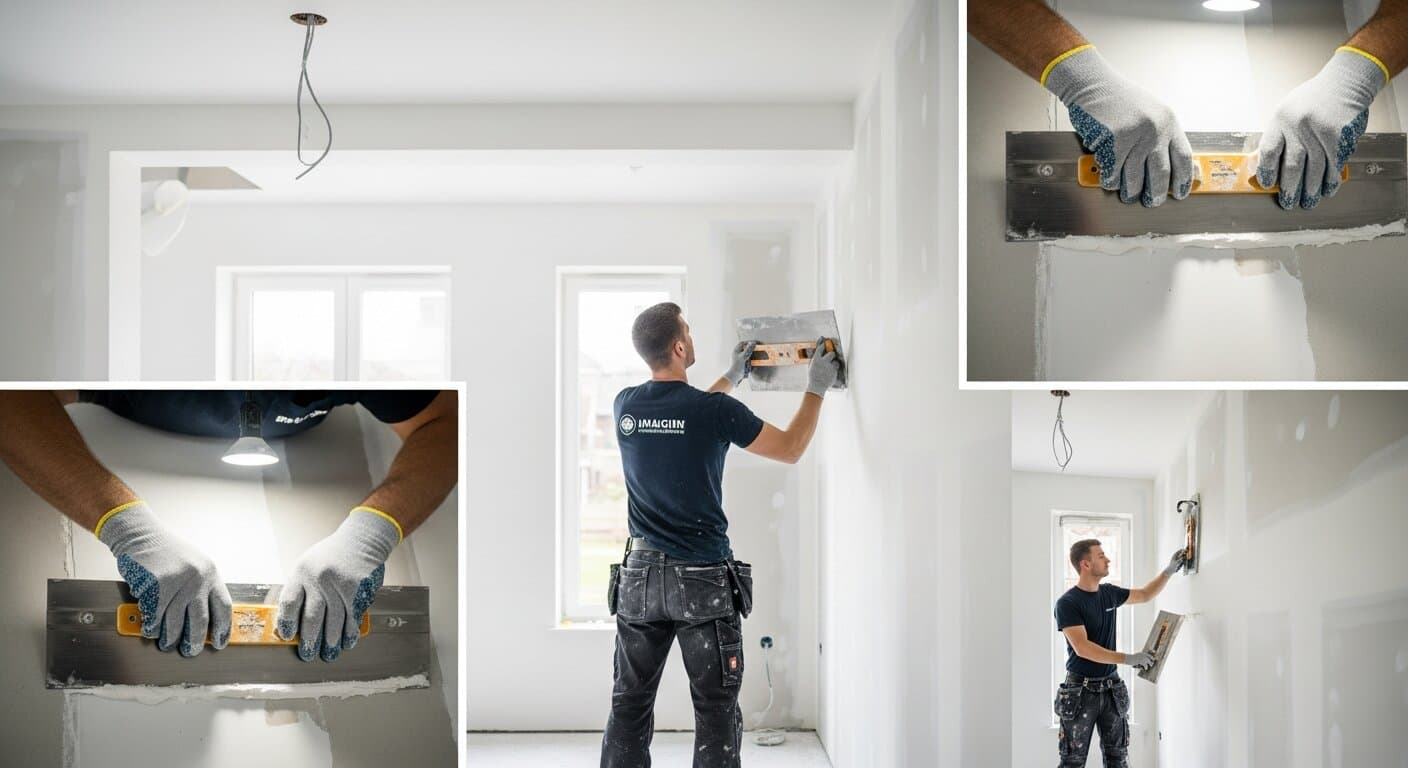
3. Photo-friendly trade. Drywall finishing is visually dramatic. A perfectly taped and feathered wall is genuinely impressive — especially compared to the rough, unfinished state before your work. Before/after content performs better for drywall than almost any other trade.
4. Price sensitivity. Homeowners often try DIY drywall and fail, then call a pro. This means your customer is already somewhat educated and is comparing you to their DIY failure. Your messaging should validate their pain (DIY drywall is harder than it looks) and justify your price (professional finish, no texture mismatch, no callbacks).
Step 1: Build the Foundation — Your Google Business Profile
For most drywall contractors, the Google Business Profile (GBP) is the highest-ROI marketing asset you have. When someone searches "drywall contractor near me" or "drywall repair [your city]," the Map Pack — those three business listings with the map — appears above all organic results and often above ads.
Getting into the Map Pack is the single fastest way to generate more drywall leads. Here's how to optimize your GBP:
Complete every field:
- Business name (exact legal name — no keyword stuffing)
- Primary category: "Drywall Contractor"
- Secondary categories: "General Contractor," "Plastering Contractor," "Flooring Contractor" (if applicable)
- Service area: list every city and town you serve
- Phone number: use the same number you use everywhere online
- Website URL: link to your drywall services page, not just your homepage
- Hours: including whether you offer emergency appointments
Add photos weekly: Google rewards active profiles with better rankings. Upload 5-10 photos of completed drywall jobs every week. Include a mix: before/after, texture work, large commercial panels, tight corner work. Label your photos with descriptive filenames before uploading (e.g., "drywall-repair-after-water-damage-chicago.jpg" vs. "IMG_4821.jpg").
Post weekly updates: Treat your GBP like a mini social media page. Post project highlights, seasonal tips ("Drywall repair before winter — why now is the time"), or new service announcements. Posts keep your profile active and signal to Google that you're a relevant, engaged business.
Collect reviews consistently: Reviews are the #1 GBP ranking factor. You need more reviews than your competitors, and you need them to keep coming in. Reach out to every completed customer with a direct link to your Google review page. Text messages convert at 3-4x the rate of email — a simple "Hey [Name], it was great working on your home. If you have 60 seconds, a Google review helps us a ton: [link]" works consistently.
Check our guide on how to get more Google reviews as a contractor for a full system.
Step 2: Build a Website That Generates Leads
You don't need a fancy website. You need a fast, professional website that ranks for your target keywords and converts visitors into calls.
Essential pages for a drywall contractor website:
| Page | Target Keyword | Purpose |
|---|---|---|
| Homepage | "Drywall contractor [city]" | Broad brand and SEO |
| Drywall Repair | "Drywall repair [city]" | Highest-intent service page |
| Drywall Installation | "Drywall installation [city]" | New construction / renovation |
| Drywall Finishing | "Drywall finishing [city]" | Texture, taping, mudding |
| Popcorn Ceiling Removal | "Popcorn ceiling removal [city]" | High-value specialty |
| Water Damage Repair | "Water damage drywall repair [city]" | Emergency high-intent |
| Commercial Drywall | "Commercial drywall contractor [city]" | B2B audience |
| Reviews / Testimonials | Brand + trust signals | Conversion support |
Each service page should be at least 600-800 words, include your city throughout the copy, list the specific process, show project photos, and have a clear "Call for a Free Estimate" CTA.
Your website also needs to load fast on mobile. Over 65% of drywall searches happen on a phone — usually from someone standing in front of a damaged wall. A site that loads in 4+ seconds will lose that lead before they ever read a word.
For a full breakdown of what a contractor website should include, read our guide on contractor website design and cost.
Step 3: Local SEO for Drywall Contractors
Local SEO for contractors is how you rank in the organic search results below the Map Pack. While GBP optimization targets the Map Pack, local SEO targets the 10 traditional search results.
The key elements of local SEO for drywall contractors:
On-page SEO:
- Include your city and state on every service page (naturally, not stuffed)
- Write a unique meta title and description for every page
- Use header tags (H1, H2, H3) to structure your content
- Include your address, phone, and service area in your website footer
Citations: A citation is any mention of your business name, address, and phone number (NAP) online. Consistency matters — if your NAP is slightly different on each directory, it confuses Google. Build citations on: Yelp, Angi, HomeAdvisor, BBB, Thumbtack, Houzz, and your local Chamber of Commerce.
Backlinks: Links from other websites to yours signal authority to Google. Easy wins: get listed in your local HBA (Home Builders Association) directory, ask your suppliers (Home Depot, local lumber yards) if they have a contractor directory, and write a guest post for a local remodeling blog.
Content marketing: A drywall contractor blog isn't just about SEO — it's about capturing people earlier in the buying journey. Topics like "how to match drywall texture" and "cost to repair drywall" attract homeowners who are researching their options. You'll be the drywall expert in their mind by the time they're ready to hire.
Step 4: Google Ads for Drywall Contractors
If you want leads now — not in 6 months — Google Ads is your answer. You can have drywall leads calling within 48 hours of launching a campaign.
The two ad types that work best for drywall contractors:
Google Local Services Ads (LSAs): These appear at the very top of Google results, above regular ads, with a "Google Screened" or "Google Guaranteed" badge. You pay per lead (not per click) — typically $20-80 per verified phone call for drywall. The badge builds immediate trust with homeowners. This is the best starting point for most drywall contractors.
Google Search Ads (PPC): Traditional pay-per-click ads that appear alongside the Map Pack and organic results. More control over targeting and messaging than LSAs, but you pay per click whether or not it converts. With a well-optimized landing page, expect to pay $150-300 per booked job for drywall.
High-intent drywall keywords to target:
- "drywall repair near me"
- "drywall contractor [city]"
- "drywall patching service [city]"
- "water damage drywall repair [city]"
- "popcorn ceiling removal [city]"
- "drywall finishing contractor [city]"
- "commercial drywall [city]"
What not to do: Don't use broad-match keywords like "drywall" or "home repair" — you'll get irrelevant clicks from people searching for DIY tutorials and drywall supply stores. Stick to specific service + location keywords and use negative keywords to exclude "how to," "DIY," "materials," and "supply."
Our Google Ads for contractors guide has more detail on campaign structure, bidding strategy, and optimization for the trades.
Step 5: Reviews — Your Most Powerful Sales Tool
In the drywall trade, homeowners are letting a stranger into their home to work on their walls. Trust is everything. Reviews are your trust proof.
The drywall contractors who dominate their markets share one trait: they have dramatically more reviews than their competitors. Not just 5 or 10 more. Often 10x more.
Our data shows that when a drywall contractor has 100+ reviews at 4.8 stars or above:
- Their Map Pack click-through rate increases by 45%
- Their conversion rate from click to call increases by 30%
- Their average job value increases by 15-20% (because high-review companies can charge premium rates)
How to build reviews consistently:
- After every completed job, send a text (not email) with a direct link to your Google review page
- Ask in person: "If you're happy with the work, I'd really appreciate a quick Google review — it helps my small business a lot"
- Include your review link on your invoice and any follow-up communications
- Respond to every review — especially negative ones — professionally and promptly
See our complete guide on contractor review management for a full playbook.
Step 6: Social Media for Drywall Contractors
Social media isn't the primary lead source for most drywall contractors — but it's where you build recognition that turns into referrals.
Instagram and Facebook are your best platforms. The drywall niche is visual — before/after photos of a smooth skim-coat finish or a complex curved wall are genuinely impressive to homeowners.
Content ideas that work for drywall contractors:
- Before/after photos of repair jobs (especially water damage → perfect finish)
- Time-lapse videos of hanging, taping, and finishing a room
- "Did you know?" posts about different texture types (orange peel, knockdown, skip trowel)
- Finished project walkthroughs from recently remodeled homes
- Team intro posts (homeowners want to know who's coming to their home)
- Tips for homeowners: "Signs you need drywall repair before painting"
Post 3-4 times per week. Consistency matters more than production quality — a phone photo of a great finished wall is better than a polished post you publish once a month.
NextDoor is an underrated platform for drywall contractors. Neighborhood-specific, high trust, and free. When homeowners ask "can anyone recommend a good drywall guy?" and your satisfied customers tag you, that's a warm lead.
Step 7: Building B2B Relationships with General Contractors and Builders
The highest-volume drywall work comes from B2B relationships: general contractors, homebuilders, property managers, and renovation companies. One good relationship with a busy GC can mean 20-30 jobs per year.
How to build these relationships:
- Join local trade associations: Home Builders Association (HBA), National Association of Remodeling Industry (NARI), Associated General Contractors (AGC). These are where GCs network.
- Attend job site walk-throughs: When you're doing a sub-bid, show up early and prepared with a professional estimate packet including your license, insurance, photos, and references.
- Be the reliable one: GCs don't always pick the cheapest sub. They pick the sub who shows up on time, communicates clearly, and doesn't cause problems. Be that drywall contractor.
- Follow up: After a project, thank the GC and ask what's coming up. A simple "looking for any upcoming projects where you'll need drywall?" message maintains the relationship.
- Create a referral incentive: Offer a cash bonus or project discount to GCs who refer new residential customers to you for direct work.
How to Price Your Drywall Services for Maximum Profit
Pricing is a marketing strategy, not just a financial one. How you present your prices affects how many jobs you win and at what margin.
Typical drywall pricing ranges (2026):
| Service | Typical Range | Notes |
|---|---|---|
| Drywall repair (small patch) | $150-400 | Minimum job fee recommended |
| Full room drywall installation | $1.50-3.50/sq ft | Material + labor |
| Drywall finishing (tape/mud) | $0.50-1.25/sq ft | Level of finish matters (L3 vs L5) |
| Popcorn ceiling removal | $1.00-2.50/sq ft | Asbestos testing may be required |
| Skim coat | $1.25-2.50/sq ft | Significant variation by condition |
| Water damage drywall repair | $300-2,500+ | Scope varies widely |
| Commercial (large sq footage) | $0.80-1.75/sq ft | Volume discount typical |
Don't compete on price alone. Compete on response time, finish quality, and reliability. The cheapest drywall contractor is rarely the most profitable one.
Putting It All Together: The 90-Day Drywall Marketing Plan
You don't need to do everything at once. Here's a phased approach:
Days 1-30 — Foundation:
- Claim and optimize your Google Business Profile completely
- Build a simple, fast website with 3-5 service pages
- Set up Google Local Services Ads
- Send review requests to your last 20 customers
Days 31-60 — Momentum:
- Build citations on 15-20 directories
- Launch a Google Ads campaign targeting your top 5 service keywords
- Post on Instagram/Facebook 3x per week
- Join and attend one local trade association meeting
Days 61-90 — Scale:
- Build out additional service/city landing pages
- Start a monthly blog post targeting informational drywall keywords
- Contact 5 local GCs about upcoming projects
- Review your ad campaign data and optimize based on which keywords are converting
By day 90, most drywall contractors following this plan are generating 10-25 new leads per month from online sources alone — on top of their existing referral base.
Ready to Grow Your Drywall Business?
The drywall contractors who build strong online marketing systems don't just get more jobs — they get better jobs at better prices, with customers who found them through Google and came in already trusting them.
RankWeld specializes in contractor SEO and lead generation for trade contractors. We understand the drywall market, we know what your competitors are doing, and we can build you a marketing system that produces consistent results month after month.
Start with a free SEO audit — we'll show you exactly where your biggest opportunities are and what it would take to own your local drywall market.
Recommended Service
Marketing Built for Your Trade
We only work with contractors. Every strategy, campaign, and website is built specifically for the trades. See what we can do for your industry.
See All ServicesRelated Articles
The Complete Contractor SEO Guide for 2026
Everything you need to know about ranking your contracting business on Google in 2026. From Google Business Profile to local SEO strategy.
Read more
How to Get More Leads as a Contractor: 15 Proven Strategies
Struggling to fill your pipeline? These 15 proven lead generation strategies help contractors get more calls, more quotes, and more booked jobs — without wasting money on bad leads.
Read more
Contractor Lead Generation: 12 Strategies Beyond Angi & HomeAdvisor
Tired of paying $50+ for shared leads on Angi and HomeAdvisor? These 12 contractor lead generation strategies build a pipeline of exclusive leads that you own and control.
Read moreReady to Put This Into Action?
Get a free SEO audit and see exactly where your contracting business stands.