
Online Reputation Management for Contractors: A Complete Guide
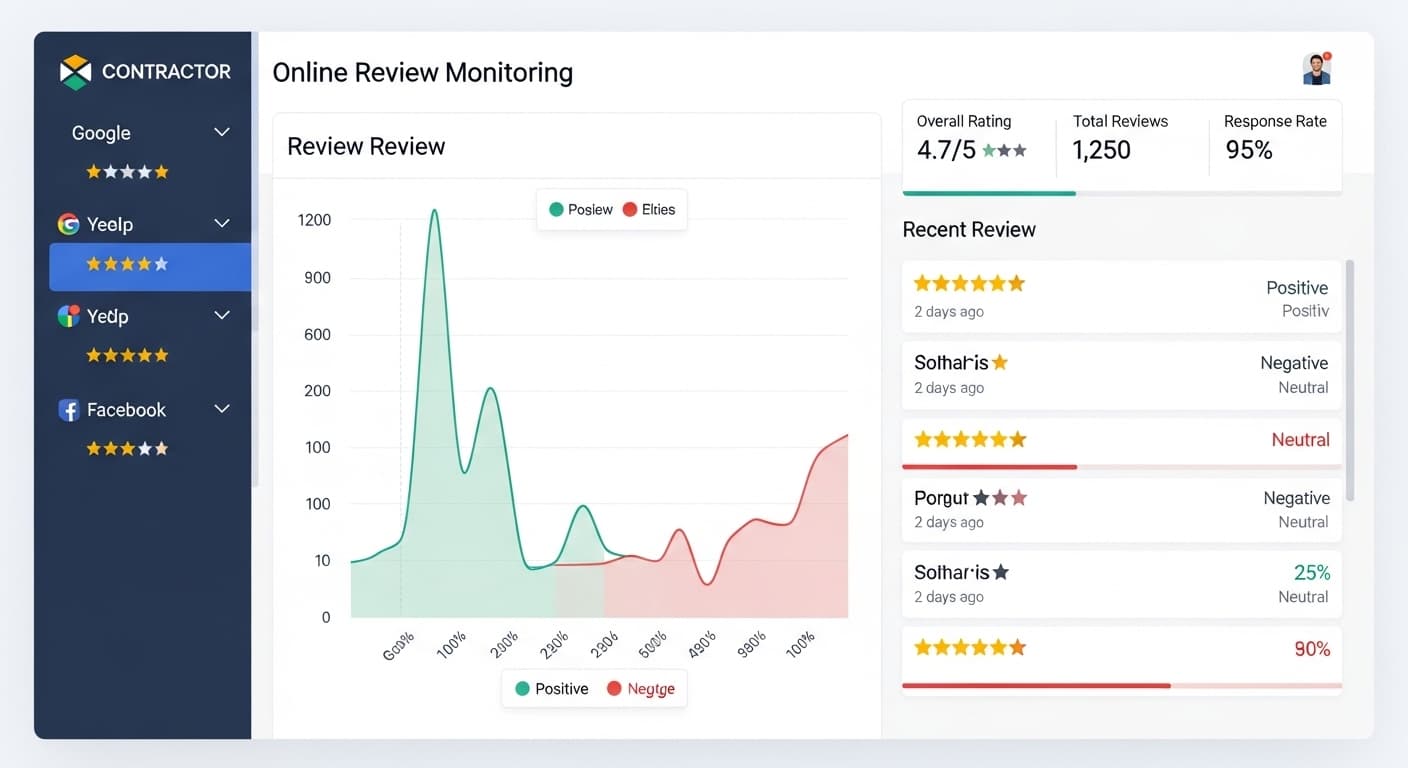
A homeowner needs their roof replaced. They search "roofing contractor near me" on Google. Three companies appear in the Map Pack:
- Roofer A: 4.9 stars, 247 reviews
- Roofer B: 4.2 stars, 38 reviews
- Roofer C: 3.8 stars, 12 reviews
Which one gets the call? You already know the answer. And it's not even close.
Your online reputation is the single most important factor in converting Google visibility into actual phone calls. You can have the best SEO in the world, but if your reviews are weak, homeowners will scroll right past you to a competitor with stronger social proof.
This guide covers everything you need to know about building, managing, and protecting your online reputation as a contractor.
Why Online Reputation Matters More Than Ever
The data is clear and unambiguous:
- 93% of consumers read online reviews before hiring a local service provider
- 84% of people trust online reviews as much as personal recommendations
- Reviews are the third most important ranking factor for Google Map Pack results
- A one-star increase in Yelp rating leads to a 5-9% increase in revenue (Harvard Business School)
- Contractors with 100+ Google reviews receive 3-5x more leads than competitors with fewer than 20
Your online reputation is not just a nice-to-have. It's a core business asset that directly impacts your revenue, your rankings, and your ability to charge premium prices.
The Reputation Ecosystem: Where It All Lives
Your online reputation exists across multiple platforms. Here's where homeowners look and what matters most:
Google (Priority 1)
Google is the center of your reputation universe. Your Google Business Profile reviews are visible every time someone searches for your business or your services. They directly impact your Map Pack ranking and your click-through rate.
What to focus on:
- Total review count (aim for 150+)
- Average rating (target 4.7-5.0)
- Recency of reviews (Google values fresh reviews)
- Review responses (respond to every single one)
- Photo content on your profile
Google Business Profile management is the foundation of your reputation strategy.
Yelp (Priority 2)
Yelp remains influential, especially in larger metropolitan markets. Yelp's recommendation filter hides reviews it considers suspicious, which means you need a high volume of reviews from established Yelp users.
What to focus on:
- Claim and fully optimize your Yelp business page
- Respond to all reviews (especially negative ones)
- Don't ask customers to review you on Yelp (Yelp's algorithm flags this)
- Focus on delivering great experiences and reviews will follow
Facebook (Priority 3)
Facebook Recommendations have replaced traditional Facebook reviews. Customers can recommend your business, and these recommendations appear on your page and in search results.
What to focus on:
- Maintain an active, professional Facebook business page
- Share positive reviews from other platforms
- Respond to all recommendations and comments
Industry-Specific Platforms
Depending on your trade, these platforms may also matter:
- Angi / HomeAdvisor -- reviews here influence lead quality if you use their platform
- BBB (Better Business Bureau) -- accreditation and reviews signal trustworthiness
- Thumbtack -- reviews drive visibility within their lead marketplace
- Houzz -- important for remodeling, design-build, and renovation contractors
- Nextdoor -- neighborhood-level recommendations
Your Own Website
Don't forget about testimonials on your own website. While third-party reviews carry more weight for credibility, website testimonials reinforce trust during the decision-making process. Feature your best reviews prominently on your homepage, service pages, and a dedicated testimonials page.
Building Your Review Volume: A Systematic Approach
Getting reviews can't be left to chance. You need a system that consistently generates new reviews without feeling pushy or artificial.
The Review Generation System
Step 1: Make it easy. Create a direct link to your Google review page. You can find this by searching your business on Google, clicking "Write a review," and copying the URL. Use a URL shortener or create a branded short link.
Step 2: Ask at the right time. The best time to ask for a review is immediately after completing a job, when satisfaction is highest. Within 2-4 hours is ideal.
Step 3: Automate the ask. Set up your CRM or review management tool to automatically send a review request via SMS (preferred) or email after every completed job.
Step 4: Make it personal. The most effective review requests come from the technician or crew who did the work, not from a generic business account. "Hi [Name], this is Mike from [Company]. I hope the [service] turned out great. Would you mind leaving us a quick Google review? It really helps our small business: [link]"
Step 5: Follow up once. If no review within 48 hours, send one follow-up message. Never send more than two requests -- you don't want to annoy the customer.
SMS vs. Email for Review Requests
- SMS open rate: 98% (response within 3 minutes average)
- Email open rate: 22% (response within hours or days)
SMS is dramatically more effective for review requests. A simple text message with a direct link generates 3-5x more reviews than email.
Example SMS:
"Hi Sarah! Thanks for choosing [Company] for your kitchen plumbing today. If you had a great experience, we'd really appreciate a quick Google review -- it means a lot to us: [link]. - Mike"
How Many Reviews Per Month?
Set a target based on your job volume. A good rule of thumb:
- Ask rate: 100% of completed jobs
- Conversion rate: 20-30% of asks result in reviews (with SMS)
- Monthly jobs: Your number
Example: 40 jobs/month x 25% conversion = 10 new reviews/month = 120 new reviews/year
At that pace, you'll build an insurmountable reputation advantage within 12 months.
A professional review management service can set up and manage this entire system for you, including automated SMS sequences, monitoring, and response management.
Responding to Reviews: Templates and Best Practices
Responding to every review -- positive and negative -- is non-negotiable. Google has confirmed that review responses are a ranking factor. Beyond SEO, responses show potential customers that you're engaged, professional, and care about customer satisfaction.
Responding to Positive Reviews
Don't just say "Thanks!" Make your response specific and personal.
Template:
Thank you, [Name]! We really enjoyed working on your [specific project/service]. [Mention a specific detail about the job if you can]. If you ever need anything in the future, don't hesitate to reach out. We appreciate your trust in [Company Name].
Key principles:
- Use the customer's name
- Reference the specific service
- Include your business name and service keywords naturally (SEO benefit)
- Invite future business
- Keep it genuine -- avoid sounding scripted
Responding to Negative Reviews
Negative reviews are inevitable. How you respond defines your brand more than the review itself. A professional, empathetic response can actually win you more customers than the negative review loses.
Template:
[Name], thank you for sharing your feedback. We're sorry to hear about your experience with [specific concern]. This doesn't reflect the standard we hold ourselves to. We'd like the opportunity to make this right -- please call me directly at [phone number] so we can discuss this. - [Your Name], Owner
Key principles:
- Respond within 24 hours
- Be empathetic, not defensive
- Acknowledge the concern without admitting fault (for liability reasons)
- Take the conversation offline (provide direct contact)
- Keep it brief and professional
- Never argue, blame the customer, or get emotional
- If the situation is resolved, politely ask if they'd consider updating their review
Responding to Fake Reviews
Unfortunately, fake reviews happen. Competitors, former employees, or people you've never served may leave fraudulent negative reviews.
Steps to address fake reviews:
- Respond professionally, noting that you can't find any record of serving this person
- Flag the review with Google (click the three dots > Flag as inappropriate)
- Report through Google Business Profile support with evidence
- If the review violates Google's policies (fake, offensive, conflict of interest), Google may remove it within 1-3 weeks
- Never engage in a public argument -- it looks bad to potential customers regardless
Protecting Your Reputation: Proactive Strategies
The best reputation management is preventing problems before they become reviews.
Set Up Monitoring
You need to know about every new review within hours, not weeks. Set up:
- Google alerts for your business name
- Review notification in your Google Business Profile app
- Third-party monitoring through your review management tool or CRM
- Social media monitoring for mentions and tags
Intercept Dissatisfied Customers
The best way to prevent negative reviews is to resolve problems before the customer feels the need to complain publicly.
The quality check call: Call or text every customer 2-3 days after completing a job. "How's everything looking? Anything we can improve?" This gives dissatisfied customers a direct channel to voice concerns -- to you, instead of to Google.
The "unhappy path" process: When a customer expresses dissatisfaction:
- Listen without defending
- Acknowledge their concern
- Offer a specific resolution (redo work, partial refund, additional service)
- Follow through promptly
- After resolution, gently ask if they'd be willing to share their experience (they often leave a positive review about how you handled the problem)
Maintain Consistent Quality
This sounds obvious, but it bears saying: the best reputation management strategy is doing excellent work consistently. Hire good people, train them well, inspect work before closing out jobs, and never cut corners.
Leveraging Your Reputation for Growth
A strong reputation isn't just a defense against negative reviews -- it's an offensive weapon that drives growth.
Use Reviews in Your Marketing
- Feature top reviews on your website homepage and service pages
- Share review screenshots on social media
- Include review quotes in your email marketing
- Reference your rating and review count in Google Ads
- Display review badges on your truck wraps and marketing materials
Charge Premium Prices
Contractors with strong reputations can charge 15-30% more than competitors. When a homeowner sees 200+ five-star reviews, they expect quality -- and they're willing to pay for it. Your reputation justifies your pricing. (See our guide on pricing contractor services for more.)
Win More Estimates
When you present an estimate, reference your online reviews. "We have a 4.9-star rating from 200+ customers on Google -- here's what they say about our work." This social proof dramatically increases close rates.
Improve SEO Rankings
Review quantity, quality, and velocity are direct ranking factors for the Google Map Pack. More reviews with higher ratings = higher rankings = more visibility = more leads. It's a virtuous cycle.
This is why contractor SEO and reputation management go hand in hand. You can't fully optimize one without the other.
Reputation Recovery: What to Do If Things Have Gone Wrong
If your online reputation has suffered -- maybe you have several negative reviews, a low average rating, or an outdated online presence -- it's not too late to recover.
The Recovery Plan
Month 1: Assess and Stabilize
- Audit all review platforms (Google, Yelp, Facebook, BBB, industry sites)
- Respond to every unanswered review (positive and negative)
- Identify and flag any fake or policy-violating reviews
- Fix any issues that are generating legitimate complaints
Month 2: Rebuild
- Implement an automated review request system
- Focus on delivering exceptional experiences to generate positive reviews
- Send personalized review requests to past satisfied customers
- Update your Google Business Profile with fresh photos and posts
Month 3-6: Grow
- Maintain consistent review generation (10+ new reviews/month)
- Monitor and respond to all new reviews within 24 hours
- Track your rating trajectory weekly
- Use positive reviews in marketing materials
The math: If you have 20 reviews with a 3.5 average, adding 50 five-star reviews brings your average to 4.6. Within 6 months of focused effort, you can completely transform your reputation.
Tools for Reputation Management
Essential (Free)
- Google Business Profile app -- manage your profile, respond to reviews, track insights
- Google Alerts -- monitor mentions of your business name online
Recommended (Paid)
- Birdeye or Podium -- automated review request sequences via SMS and email
- GoHighLevel -- all-in-one CRM with review management features
- ReviewTrackers -- monitor reviews across 100+ platforms
Professional Management
If reputation management feels like too much to handle alongside running your business, a professional review management service can handle the entire system -- from automated requests to response management to monitoring and reporting.
Common Reputation Mistakes Contractors Make
Not asking for reviews. If you don't ask, you don't get. Happy customers rarely leave reviews on their own -- they're busy living their lives. You need to ask, consistently and systematically.
Only asking happy customers. This creates an obviously filtered profile. Ask every customer. Your average will naturally be high if you do good work, and the occasional lower rating makes your profile look authentic.
Responding emotionally to negative reviews. Every response is public and permanent. Take 24 hours to cool down before responding. Always be professional, even when the reviewer isn't.
Ignoring other platforms. While Google is king, homeowners check multiple sites. A great Google profile with a terrible Yelp page sends mixed signals. Maintain consistency across all platforms.
Treating reputation as a one-time project. Reputation management is an ongoing process, not a project with an end date. The moment you stop generating reviews, your competitors start catching up.
Your Reputation Is Your Growth Engine
Every five-star review is a salesperson working for you 24/7. It's visible to every homeowner who searches for your services. It builds trust before you ever answer the phone. And it compounds over time, creating a competitive moat that's incredibly hard for competitors to match.
Start today. Set up a review request system. Respond to your existing reviews. And commit to delivering the kind of experience that makes five-star reviews inevitable.
For the tactical side of review collection, read our guide on how to get more Google reviews as a contractor and our review management playbook.
Need help building your reputation system? Get a free SEO audit that includes a reputation assessment across all major platforms. We'll show you exactly where you stand and what to do next. Or contact us to discuss professional review management and Google Business Profile optimization.
Recommended Service
Want More 5-Star Reviews on Autopilot?
Our automated review management system helps contractors collect, manage, and leverage reviews to win more jobs.
Explore Review ManagementRelated Articles
How to Get More Google Reviews as a Contractor
Google reviews are the #1 trust factor for homeowners hiring a contractor. This guide gives you a step-by-step system for getting more reviews consistently — including scripts, timing, and automation tools.
Read more
How Many Google Reviews Do Contractors Actually Need?
Reviews are the #1 trust factor for hiring contractors. Here's exactly how many you need, why they matter for SEO, and how to get them on autopilot.
Read more
Review Management for Contractors: The Complete Playbook
Reviews are the most powerful trust signal for contractors. This playbook covers everything: how to get more reviews consistently, handle negative feedback, and use reviews to dominate local search.
Read moreReady to Put This Into Action?
Get a free SEO audit and see exactly where your contracting business stands.