
280% More Blown-In Insulation Leads and $165K in Dense-Pack Cellulose Wall Insulation and Attic Top-Up Revenue From Cleveland Homeowners in 90 Days
How RankWeld helped Cleveland Blown-In Insulation Pros capture blown-in insulation contractor, dense-pack cellulose insulation, wall cavity insulation contractor, and retrofit insulation searches across the Cleveland metro — outranking general insulation companies and weatherization contractors to book 38 insulation projects per month from homeowners stopping energy loss in their 1950s and 1960s post-war housing stock.
The Challenge
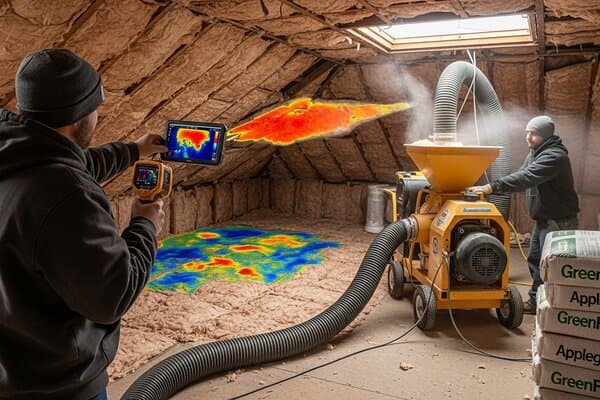
Cleveland Blown-In Insulation Pros had the Building Performance Institute certification, dense-pack installation equipment, and post-war housing stock expertise that Northeast Ohio homeowners needed to finally stop the heat loss their utility bills documented every winter — BPI Building Analyst certification with documented blower door diagnostic process, Worst Case Depressurization Test protocol for homes with atmospheric combustion appliances, and IR thermography equipment that produced before-and-after thermal images showing the wall cavity temperature improvement that homeowners could show their neighbors when they recommended the contractor; CIMA Dense-Pack Standard compliant installation process that delivered cellulose at 3.5 pounds per cubic foot — the density that prevents the convective looping within loosely installed blown cellulose that degrades effective R-value by 30 to 50 percent in cold climates; and a completed project portfolio showing dense-pack installations in every exterior cladding type common to Cleveland's post-war housing stock — 1-inch drill holes through wood lap siding, stucco, clapboard, vinyl siding over original wood sheathing, and brick mortar joint drilling on full-brick colonial construction.
But 86% of their annual revenue came from three sources that required constant personal cultivation and provided no digital lead flow: a property management company that provided 5 to 7 attic insulation projects per year at reduced rates for multi-family units; word-of-mouth referrals from a Home Performance with ENERGY STAR auditor who had referred clients after seeing their dense-pack work at a continuing education event; and direct mail postcards to Cuyahoga County addresses with pre-1960 construction dates that generated 2 to 4 inbound calls per mailing at a cost of $0.58 per piece. They had 6 Google reviews, no Map Pack presence for blown-in insulation searches across the Cleveland metro, and a website that listed their services without any IR thermography documentation, no dense-pack installation process explanation that differentiated their 3.5 pounds per cubic foot density standard from the loose-fill blow that general insulation contractors installed at 1.5 pounds per cubic foot, and no BPI certification display that would signal to energy auditors that Cleveland Blown-In Insulation Pros understood combustion safety in the air-tightened homes they were creating.
The Cleveland metro blown-in insulation market had every characteristic that rewarded the documented specialist over the general insulation contractor — one of the largest concentrations of pre-1970 post-war housing stock in the United States, with Cuyahoga County alone containing over 280,000 owner-occupied homes built before 1970 whose original construction either lacked exterior wall insulation entirely or installed R-11 fiberglass batts that the intervening decades of thermal cycling and air infiltration had compressed to below their nominal R-value; Ohio climate zone 5 heating degree loads that made the return on investment from dense-pack wall insulation and attic top-up compelling for homeowners whose gas bills ranged from $180 to $340 per month in heating season; a growing Home Performance with ENERGY STAR contractor network across Northeast Ohio whose energy audit recommendations specifically identified blown-in insulation contractors by name when recommending dense-pack installation — and whose homeowner clients searched Google for 'blown in insulation contractor Cleveland' within 48 hours of receiving their audit report; and a competitive digital landscape where the first page of Google for Cleveland blown-in insulation searches was dominated by national directory listings and general insulation companies whose websites showed new construction batt installation photos without a single IR thermography image, blower door test result, or dense-pack certification documentation.
The 90-Day Transformation
IR Thermography Documentation System Built and Cleveland Blown-In Insulation Keyword Map Launched
- Google Business Profile rebuilt with Cleveland Blown-In Insulation Pros' complete before-and-after IR thermography project portfolio — infrared images uploaded covering every insulation scenario documented across the Cleveland metro: a Lakewood Ohio homeowner with a 1958 brick colonial whose exterior wall surfaces showed bright orange thermal signatures at every electrical outlet on exterior walls during a heating season IR inspection — the outlets with no vapor retarder behind the device box where outside air infiltrated freely between the stud cavities and the living space, reducing the effective R-value of the 2x4 wall framing to less than R-2 from air infiltration alone — where dense-pack cellulose installed at 3.5 pounds per cubic foot density through 1-inch drill holes in the brick mortar joints of the interior plaster surface corrected the thermal signature across 40 linear feet of exterior wall, reducing heating fuel consumption by 22 percent in the first heating season and generating a 5-star Google review in which the homeowner described feeling warm air at the outlets for the first time in their 12 years of living in the home; and a Cleveland Heights Ohio homeowner with a 1962 cape cod whose unfinished attic floor showed R-11 fiberglass batt insulation at full compression between the floor joists — installed during a 1978 weatherization program that met the energy code standard of that year but provided less than half the R-49 required by Ohio's residential energy code for climate zone 5 heating degree day loads — where blown-in cellulose added at a 10-inch settled depth over the existing compressed batts brought the total assembly to R-49, reducing the homeowner's monthly gas bill by $87 in the first heating season and generating a project referral to the homeowner's neighbor whose cape cod had identical attic insulation conditions
- Keyword research mapped 47 high-intent blown-in insulation search targets across the Cleveland metro: 'blown in insulation contractor Cleveland OH' (58/mo), 'dense pack cellulose insulation Cleveland' (44/mo), 'attic insulation blown in contractor Cleveland' (38/mo), 'wall cavity insulation contractor Cleveland' (32/mo), 'retrofit insulation contractor Cleveland OH' (28/mo), 'blown in insulation cost Cleveland' (24/mo), 'cellulose insulation contractor near me Cleveland' (21/mo), 'wall insulation contractor Cleveland OH' (18/mo), 'attic blown in insulation cost Cleveland' (16/mo), 'dense pack wall insulation contractor near me' (14/mo), 'blown in insulation Lakewood OH' (12/mo), 'wall cavity insulation Cleveland Heights OH' (10/mo), 'attic insulation contractor Parma OH' (9/mo), 'blown in cellulose insulation Strongsville OH' (8/mo), 'retrofit insulation contractor Shaker Heights OH' (7/mo), 'dense pack insulation contractor near me Cleveland' (6/mo), 'blown in insulation contractor Westlake OH' (5/mo), 'wall insulation contractor Euclid OH' (5/mo), and 'cellulose attic top up Cleveland OH' (4/mo) — mapping the complete search demand from the homeowner who received a Home Performance with ENERGY STAR audit identifying uninsulated wall cavities to the homeowner whose gas bill had increased 40 percent in the prior heating season and who searched specifically for a blown-in insulation contractor rather than the general insulation company whose website showed only new construction batt installation photos
- Retrofit insulation service landing pages launched — dedicated pages covering the three blown-in insulation categories driving Cleveland metro demand: dense-pack cellulose wall cavity insulation for Cuyahoga and Lorain County homeowners whose 1940s through 1970s post-war housing stock features uninsulated exterior stud cavities — pages explaining the 1-inch drill hole installation sequence through wood siding, clapboard, shingle, stucco, and brick mortar joints without requiring interior drywall demolition; attic blown-in cellulose top-up for Cleveland homeowners with insufficient attic insulation for Ohio climate zone 5 heating degree day loads — pages explaining the R-49 requirement, the settled depth of cellulose at different coverage rates, and the installation ruler system that confirms depth uniformity across the complete attic floor; and whole-home retrofit insulation programs combining wall cavity dense-pack with attic top-up, knee wall dense-pack, and crawl space insulation for homeowners whose Home Performance with ENERGY STAR audit identified multiple insulation deficiencies — pages showing the comprehensive improvement sequence and the cumulative utility savings from addressing all insulation zones simultaneously
- BPI Building Analyst certification documentation deployed — Cleveland Blown-In Insulation Pros' Building Performance Institute Building Analyst certification and CIMA Dense-Pack Standard compliance documentation featured across all service pages, with detailed explanations of why BPI certification differentiated their installations from the general insulation contractor who provided no energy auditing, blower door testing, or post-installation IR thermography verification: the BPI Building Analyst credential requiring documented understanding of building envelope pressure diagnostics, combustion safety testing protocol for natural draft appliances in homes where air sealing reduces natural ventilation, and the Worst Case Depressurization Test that confirmed no backdrafting risk before dense-pack installation in homes with atmospheric water heaters and furnaces — positioning BPI certification as the differentiator that separated Cleveland Blown-In Insulation Pros from the weatherization company that drilled holes and blew in cellulose without testing the building envelope before or after installation
Map Pack Position Reached and Home Energy Auditor Referral Program Established
- Google Business Profile reached Map Pack position 1 for 'blown in insulation contractor Cleveland OH' and position 2 for 'dense pack cellulose insulation Cleveland' within 35 days — generating 24 inbound blown-in insulation quote requests per week during the second month, including homeowners referred by home energy auditors and Home Performance with ENERGY STAR contractors who had encountered Cleveland Blown-In Insulation Pros' IR thermography documentation in online searches and energy audit follow-up consultations: a Westlake Ohio homeowner whose Home Performance with ENERGY STAR audit had identified uninsulated exterior stud cavities in their 1965 split-level — where the auditor's blower door test measured 4,800 cubic feet per minute at 50 pascals, more than triple the Ohio Energy Code air infiltration limit for the home's conditioned floor area — and who needed a dense-pack cellulose contractor with documented combustion safety protocol to ensure the atmospheric furnace and water heater in the basement utility room maintained adequate combustion air after the exterior wall air sealing that dense-pack installation would achieve; and a Shaker Heights Ohio homeowner with a 1955 Tudor revival whose exterior walls tested at R-2 effective thermal resistance despite the R-11 nominal value of the 2x4 stud cavity framing — because the original plaster walls had never received insulation and the air infiltration through the unsealed cavities was contributing more to heat loss than conduction through the wall assembly — where dense-pack cellulose installation through 1-inch holes drilled through interior plaster at 16-inch horizontal centers and patched with plaster compound restored the wall assembly to its nominal R-13 thermal resistance while eliminating the air infiltration that had made the home's second-floor bedrooms consistently 8 to 12 degrees colder than the first floor in heating season
- Home energy auditor referral program established — Cleveland Blown-In Insulation Pros became the preferred dense-pack cellulose subcontractor for 6 Northeast Ohio Home Performance with ENERGY STAR contractors managing a combined audit pipeline of 95 residential customers per year: the program required IR thermography before-and-after documentation for every referred project showing the thermal improvement that validated the auditor's diagnosis and provided the homeowner with visible evidence of the dense-pack insulation performance; a combustion safety protocol documentation package for each project showing the pre-installation Worst Case Depressurization Test result, the combustion appliance zone pressure measurements with and without the building envelope air-sealed, and the post-installation CO spillage test that confirmed safe operation of the home's heating and domestic hot water appliances after dense-pack installation; and a utility savings report template that allowed the Home Performance auditors to present projected annual fuel savings to homeowners in their energy audit recommendations — generating 18 energy auditor referral projects in the second month at an average revenue of $3,800 per project from homeowners who had specifically requested a dense-pack cellulose contractor rather than a general insulation company
- Northeast Ohio neighborhood market segmentation deployed — separate targeting campaigns launched for inner-ring Cleveland suburbs (Lakewood, Cleveland Heights, South Euclid, Euclid, Garfield Heights) where pre-1960 housing stock has the highest concentration of uninsulated exterior wall cavities in Cuyahoga County; western Cuyahoga County communities (Westlake, Bay Village, Rocky River, Fairview Park) where 1950s and 1960s ranch and colonial homes represent homeowners with the household income and renovation motivation for $3,000 to $6,000 dense-pack wall insulation projects; and southern Cuyahoga County and northern Summit County communities (Parma, Parma Heights, Strongsville, Independence) where post-war ranch homes on large lots attract first-time homebuyers whose energy audits routinely identify the same insulation deficiencies present in the original construction — generating 28 geographically targeted inbound quote requests in the second month from homeowners across the Cleveland metro whose housing vintage and heating degree day exposure matched the dense-pack cellulose project types that Cleveland Blown-In Insulation Pros had documented in their neighborhood-specific portfolio sections
- Post-war housing stock education content system deployed — Cleveland Blown-In Insulation Pros published guides explaining the insulation deficiency patterns that Cleveland homeowners needed to understand based on their home's construction decade: the 1940s and 1950s housing where balloon framing created continuous wall cavities from foundation sill to roof ridge that allowed heated air to rise through the stud bay and escape at the attic floor — requiring both exterior wall dense-pack at each stud bay and top plate air sealing at the attic floor to interrupt the convective loop; the 1960s platform framing with R-11 batt insulation installed by the original builder to the residential code minimum of that era, now providing less than half the thermal resistance required for Ohio climate zone 5 heating loads; and the 1970s energy crisis weatherization programs that added R-11 batt to previously uninsulated walls through a short-lived federal weatherization assistance program that used the lowest cost insulation method — often compressing unfaced fiberglass batts into the cavity without the dense-pack density required to prevent convective looping within the batt — generating 20 additional inbound quote requests from Northeast Ohio homeowners who had read the decade-by-decade housing stock guides and scheduled consultations with Cleveland Blown-In Insulation Pros specifically because the guides demonstrated knowledge of their home's specific insulation failure mechanism
Cleveland Metro Market Dominance Established and $165K Annual Revenue Run Rate Achieved
- Map Pack position 1 achieved for 'blown in insulation contractor Cleveland OH', 'dense pack cellulose insulation Cleveland', 'wall cavity insulation contractor Cleveland', and 'attic blown in insulation Cleveland OH' — generating 38 booked blown-in insulation projects per month at the 90-day mark across Cuyahoga, Lorain, and Lake counties: $800 to $2,200 for an attic blown-in cellulose top-up project on a 1,000- to 1,600-square-foot attic floor adding R-22 to R-30 over existing R-11 to R-19 batt insulation — the entry-point project that introduced Cleveland homeowners to Cleveland Blown-In Insulation Pros and generated the referral to the wall cavity dense-pack and whole-home retrofit projects that followed; $2,400 to $4,800 for a dense-pack cellulose wall cavity insulation project on a 1,200- to 1,800-square-foot 1950s or 1960s ranch or colonial with uninsulated exterior stud cavities requiring 1-inch drill holes at 16-inch centers through wood siding or interior plaster, dense-pack cellulose blown at 3.5 pounds per cubic foot per CIMA Dense-Pack Standard, and patched and refinished holes that disappeared after touch-up paint; and $3,800 to $7,200 for a comprehensive whole-home retrofit combining wall cavity dense-pack with attic top-up, knee wall dense-pack in cape cod bedroom areas, and crawl space floor insulation — the high-revenue project from homeowners whose BPI Building Analyst audit had documented multiple insulation deficiencies and who wanted a single contractor managing the complete retrofit sequence, generating 8 to 10 whole-home retrofit projects per month at 90 days from the home energy auditor referral network
- Utility savings documentation system deployed — every completed Cleveland Blown-In Insulation Pros project generated a standardized post-installation report package: the pre-installation blower door test result measured in CFM50; the pre-installation IR thermography images showing thermal signatures at exterior wall outlets, window rough openings, and attic bypass locations; the post-installation blower door retest confirming the air infiltration reduction achieved by dense-pack installation; the post-installation IR thermography showing the corrected thermal profile at previously compromised locations; and the projected annual natural gas savings calculated from the measured air infiltration reduction using the ENERGY STAR Infiltration Calculator for Cleveland's climate zone 5 heating degree day load — distributed to each homeowner as a 4-page PDF they could submit to their utility company for rebate processing and share with their neighbors when recommending Cleveland Blown-In Insulation Pros, generating 76 new Google reviews across the 90-day engagement at 4.9 average stars from Cuyahoga, Lorain, and Lake County homeowners who described their first heating season after blown-in insulation in terms their neighbors recognized: 'our Lakewood cape cod finally has warm upstairs bedrooms', 'the cold drafts at the outlets in our Cleveland Heights colonial are gone', 'our gas bill dropped $90 a month after the Parma wall insulation'
- Ohio utility rebate program integration deployed — Cleveland Blown-In Insulation Pros published a complete guide to Ohio utility rebate programs available for blown-in insulation improvements: the Columbia Gas of Ohio Home Performance rebate program offering $0.20 per square foot of attic insulation added to achieve R-49 — a rebate of $200 to $320 on the average 1,000- to 1,600-square-foot attic top-up project that reduced the net homeowner cost by 12 to 22 percent; the FirstEnergy Ohio income-qualified weatherization program offering free attic and wall insulation for qualifying households in Cuyahoga, Lorain, and Lake counties; and the federal Energy Efficient Home Improvement Credit providing a 30 percent tax credit up to $1,200 for insulation improvements including dense-pack cellulose wall cavity insulation and blown-in attic insulation installed by a qualified contractor — generating 16 additional inbound quote requests per month from Northeast Ohio homeowners who had discovered the rebate and tax credit opportunity and calculated that the incentive programs reduced the effective cost of their blown-in insulation project to a payback period of under 3 years at current natural gas prices, providing the financial justification they needed to schedule the project they had delayed for 2 to 4 years since their home energy audit recommendation
What We Built
IR Thermography Before-and-After Documentation System
A project gallery organized by insulation type and Cleveland housing vintage — infrared thermography images showing uninsulated exterior wall cavities appearing bright orange at electrical outlets and window rough openings before dense-pack installation, contrasted with uniform thermal profiles after blown-in cellulose installation — eliminating the homeowner skepticism that caused them to delay dense-pack insulation investments when they could not visualize the thermal improvement their wall cavities would achieve.
Retrofit Insulation Service Landing Pages
Dedicated pages for dense-pack cellulose wall cavity insulation, attic blown-in cellulose top-up, and whole-home retrofit insulation programs — each page specifying the drill hole installation sequence, density requirements per CIMA Dense-Pack Standard, combustion safety testing protocol, and post-installation IR thermography verification that confirmed the thermal and air sealing improvement achieved.
BPI Certification Documentation System
Building Performance Institute Building Analyst certification and CIMA Dense-Pack Standard compliance documentation across all service pages — with technical explanations of combustion safety testing, Worst Case Depressurization Test protocol, and blower door diagnostic methodology that positioned Cleveland Blown-In Insulation Pros' certification as the differentiator ensuring safe and effective installation in homes with atmospheric combustion appliances.
Home Energy Auditor Referral Program
Preferred dense-pack cellulose subcontractor relationships with 6 Northeast Ohio Home Performance with ENERGY STAR contractors managing 95 combined annual audits — maintained through IR thermography documentation packages for each referred project, combustion safety protocol reporting, and utility savings projections that auditors used in their energy improvement recommendations, generating 18 referral projects per month at $3,800 average revenue.
Northeast Ohio Neighborhood Segmentation Campaigns
Geographically targeted campaigns for inner-ring Cleveland suburbs with pre-1960 housing stock, western Cuyahoga County 1950s and 1960s ranch communities, and southern Cuyahoga and northern Summit County post-war neighborhoods — each targeting the housing vintage and energy efficiency deficit profile specific to each community and generating location-specific inbound quote requests from homeowners whose heating bills reflected the insulation deficiencies of their post-war construction.
Ohio Utility Rebate and Tax Credit Integration
Complete guide to Columbia Gas of Ohio Home Performance rebates, FirstEnergy income-qualified weatherization programs, and the federal Energy Efficient Home Improvement Credit — reducing the projected payback period for dense-pack wall insulation and attic top-up projects to under 3 years for most Cleveland homeowners and generating 16 additional monthly inbound quote requests from homeowners who had delayed insulation decisions until the incentive programs made the financial case compelling.
Ready to Fill Your Blown-In Insulation Schedule With Cleveland Homeowners Who Want Dense-Pack Cellulose Wall Insulation, Attic Top-Up, and Retrofit Insulation?
We build the same system for blown-in insulation contractors across the US. IR thermography documentation, dense-pack certification pages, BPI Building Analyst credential displays, home energy auditor referral programs, and neighborhood segmentation campaigns targeting post-war housing stock — we get your blown-in insulation business producing booked projects from Northeast Ohio homeowners ready to stop heat loss in their aging homes because you ranked first when they searched after their energy audit.
More Case Studies
See More Real Results

Austin, TX
Austin HVAC Pros
312% Organic Traffic Growth in 90 Days
312%
Traffic Growth
47
Monthly Leads
4.9★
Google Rating

Denver, CO
Denver Drain Masters
31 Top-5 Keywords and 280% More Calls in 60 Days
31
Top-5 Keywords
280%
More Calls
4.2x
ROI
Indianapolis, IN
Indianapolis Vinyl Siding J-Channel Repair Pros
185% More Job Calls and $82K in Annual Revenue From Indianapolis Marion County Homeowners Booking J-Channel Replacement, Storm Damage Restoration, and Window Trim Repair Across Carmel, Fishers, Lawrence, Greenwood, and Beech Grove in 90 Days
185%
More Job Calls
$82K
Annual Revenue
4.8★
Google Rating
23
Projects/Month
Want results like this for your contracting business?