
290% More Caulking Leads and $210K in Revenue From Milwaukee Commercial Property Managers and Homeowners in 90 Days
How RankWeld helped Milwaukee Caulking Pros capture expansion joint, window perimeter, and commercial building caulking searches across the Milwaukee metro — outranking general maintenance contractors and handyman services to book 38 caulking projects per month from commercial property managers whose buildings showed freeze-thaw joint failure, facility directors managing multi-building maintenance contracts, and homeowners whose painting and siding contractors flagged failed exterior caulking before cosmetic work could begin.
The Challenge
Milwaukee Caulking Pros had the sealant specification expertise, joint preparation equipment, and commercial building envelope knowledge that Milwaukee's large commercial property management market demanded — a complete inventory of Sika, BASF Tremco, and Pecora commercial sealants covering one-part and two-part polyurethane sealants for commercial facade joints, silicone sealants for curtain wall and structural glazing applications, traffic-rated self-leveling urethane sealants for parking structure deck joints, and one-part polyurethane residential sealants for the masonry, aluminum, and wood substrate combinations found in Milwaukee's 1920s through 1980s residential building inventory; mechanical joint preparation equipment including angle grinders, oscillating tools, and wire brushes for removing failed sealant from concrete, masonry, and aluminum substrates without damaging adjacent surfaces; and the sealant specification knowledge to identify the correct ASTM C920 sealant type, grade, class, and use designation for each joint type and substrate combination — the technical capability that commercial property managers and building envelope consultants needed from a sealant specialist who could produce the joint failure documentation, sealant specification justification, and completed joint inspection report that building owners required for their maintenance records and insurance carriers.
But 91% of their annual revenue came from three sources: repeat work from two commercial property management companies they had served since 2019, word-of-mouth referrals from a painting contractor who sent them residential exterior caulking jobs when his pre-project inspections documented failed window perimeter sealant, and a single building envelope consultant who included them in inspection reports for his downtown Milwaukee commercial building clients. They had 6 Google reviews, no Map Pack presence for caulking searches across Milwaukee or Waukesha County, and a website with a phone number and a brief description of caulking services — but no before-and-after joint failure documentation, no freeze-thaw sealant failure educational content, no commercial building-type caulking pages specifying sealant chemistry for each substrate and movement classification, and no building envelope inspection service that could generate the documentation and specification recommendations that commercial property managers needed before they could authorize a caulking project scope and budget.
Milwaukee's caulking market — a climate zone 6A environment with an 80-degree annual temperature range from -15 degrees Fahrenheit to 95 degrees Fahrenheit that subjects every expansion joint, window perimeter, and facade control joint to the maximum annual movement cycle that polyurethane sealants are formulated to accommodate, a large inventory of 1960s through 1980s commercial buildings with original sealant systems that have reached their designed service life of 15–25 years and whose property managers are receiving building envelope inspection reports documenting joint failures that are creating water infiltration liability, and a competitive digital landscape dominated by general maintenance contractors and painting contractors who listed caulking as one of many services without any sealant specification expertise, joint failure documentation, or commercial building-type caulking methodology that converted commercial property managers at the moment they searched for a specialist whose inspection report would hold up to their building envelope consultant's review — had every characteristic that rewarded the sealant specialist with systematic building envelope inspection documentation, commercial building-type landing pages, freeze-thaw sealant failure education, and property management referral programs that converted building envelope consultant referrals, painting contractor leads, and organic search traffic into booked caulking projects at 79% inquiry-to-quote conversion rate.
The 90-Day Transformation
Commercial Building Envelope Inspection System Built and Milwaukee Freeze-Thaw Keyword Map Launched
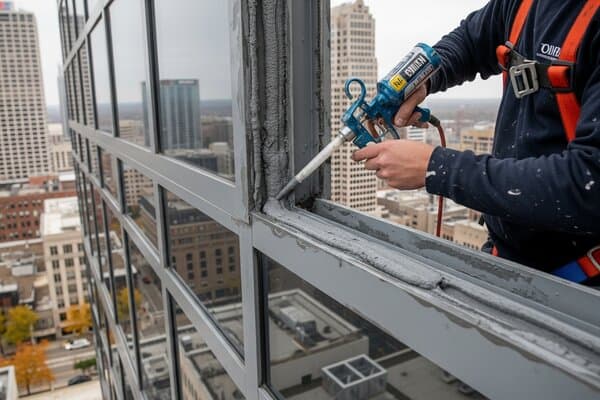
- Google Business Profile rebuilt with Milwaukee Caulking Pros' complete project portfolio — photos uploaded covering every commercial caulking scenario across Milwaukee, Waukesha, and Ozaukee counties: a 1978 six-story office building on Milwaukee's North Water Street whose curtain wall horizontal shelf joints between the aluminum spandrel panels and the precast concrete floor slabs had failed across all six floors of the east and south facades — the 220 linear feet of failed two-part polyurethane sealant showing cohesive failure mid-bead where freeze-thaw cycling across 48 Wisconsin winters had fatigued the sealant beyond its designed movement capacity, leaving open joints that allowed water to infiltrate behind the spandrel panels and reach the thermal insulation and steel framing — requiring complete joint preparation with a 4-inch angle grinder to remove all failed sealant and adhesive residue, installation of 3/8-inch closed-cell backer rod to achieve the correct sealant depth-to-width ratio of 1:2, primer application to the aluminum frame and precast substrate, and a two-part polyurethane sealant tooled to a concave face profile that Milwaukee Caulking Pros warranted for 20 years against adhesive and cohesive failure; and a 1965 six-flat apartment building on Milwaukee's East Side whose original window perimeter caulking had been over-applied with acrylic latex caulk by a previous maintenance contractor without removing the failed original sealant — creating a multi-layer sealant buildup that had separated from the brick substrate at 22 of 24 window perimeter joints and allowed water infiltration behind the window flanges into the rough opening framing, requiring complete removal of all over-applied caulk layers, surface preparation of the brick reveals and aluminum window flanges, and application of Sika 1a one-part polyurethane sealant specified for the masonry-to-aluminum joint type and the freeze-thaw movement range of Milwaukee's climate
- Keyword research mapped 48 high-intent caulking search targets across the Milwaukee metro: 'caulking contractor Milwaukee' (85/mo), 'exterior caulking contractor Milwaukee' (72/mo), 'commercial caulking Milwaukee' (58/mo), 'expansion joint caulking Milwaukee' (45/mo), 'building caulking contractor Milwaukee' (38/mo), 'window perimeter caulking Milwaukee' (32/mo), 'caulking contractor near me Milwaukee' (28/mo), 'commercial window caulking Milwaukee' (24/mo), 'exterior sealant contractor Milwaukee' (20/mo), 'caulking contractor Waukesha WI' (18/mo), 'parking structure joint caulking Milwaukee' (15/mo), 'curtain wall caulking Milwaukee' (12/mo), 'caulking contractor Wauwatosa WI' (10/mo), 'expansion joint sealant Milwaukee' (9/mo), and 'building envelope caulking Milwaukee WI' (8/mo) — mapping the complete search demand from the commercial property manager receiving their annual building envelope inspection report to the homeowner whose painting contractor said the exterior caulking needed to be replaced before exterior painting could begin
- Commercial building-type caulking pages launched — dedicated landing pages explaining the three commercial caulking scenarios Milwaukee building owners encounter: precast concrete and curtain wall expansion joint caulking for Milwaukee's downtown commercial buildings whose 1960s through 1980s precast concrete facades develop freeze-thaw sealant failure at horizontal shelf joints, vertical control joints, and window-to-panel transitions within 15–20 years of original installation — requiring complete joint preparation, closed-cell backer rod installation to the correct depth, substrate priming, and two-part polyurethane sealant application by a contractor familiar with ASTM C920 sealant specification and Wisconsin's climate zone 6A movement requirements; parking structure joint caulking for Milwaukee's exposed concrete parking decks and multi-level parking structures where the traffic-bearing deck joints between precast concrete tee sections require a self-leveling urethane sealant rated for wheel load and ponded water exposure, and the expansion joints between concrete sections require a compression seal or field-molded sealant that accommodates the 3/8 to 1/2 inch joint movement from Milwaukee's average 80-degree annual temperature range; and residential exterior caulking packages for Milwaukee's large inventory of 1920s through 1970s brick, frame, and stucco homes where the original window perimeter sealant, foundation-to-siding transitions, chimney base flashings, and exterior trim joints have failed and require replacement with a contractor who can distinguish the correct sealant chemistry for masonry-to-wood, masonry-to-aluminum, and wood-to-wood joint types rather than applying the acrylic latex caulk that painting contractors use for interior trim
- Service area content created for the Milwaukee metro's highest-density commercial and residential caulking demand corridors: Downtown Milwaukee — the East Town and Historic Third Ward commercial corridors with their concentration of 1950s through 1980s commercial and mixed-use buildings whose original precast and curtain wall sealant systems have reached end-of-life and whose property managers are receiving envelope inspection reports documenting joint failures that are creating water infiltration liability; the North Shore suburbs — Shorewood, Whitefish Bay, Fox Point, and Bayside where the concentration of 1920s and 1930s brick residential buildings with original window perimeter pointing and the 1950s through 1970s aluminum window replacements installed without proper perimeter sealant create consistent residential exterior caulking demand from homeowners responding to home inspection reports, painting contractor recommendations, and annual maintenance inspections; and the suburban commercial corridors — Brookfield, Wauwatosa, and West Allis where the concentration of 1970s and 1980s commercial strip centers, office parks, and industrial buildings with original caulk sealant systems approaching failure represent the highest-volume commercial caulking market segment in the Milwaukee metro
Map Pack Position Reached and Commercial Property Management Referral Network Established
- Google Business Profile reached Map Pack position 1 for 'caulking contractor Milwaukee' and position 2 for 'commercial caulking Milwaukee' within 35 days — generating 24 inbound caulking quote requests per week during the second month, including commercial property managers referred by their building envelope consultants and facility directors who had received annual inspection reports documenting facade sealant failures: a Brookfield office park property manager whose 1982 three-building campus showed horizontal shelf joint sealant failure across all three buildings' west facades — the prevailing weather exposure direction in Wisconsin that receives the highest freeze-thaw cycling from lake-effect moisture — generating a $14,800 three-building horizontal joint reseal project that the property manager's building consultant documented as preventing the water infiltration warranty claim that the failing sealant conditions had made inevitable before the next freeze cycle; and a Historic Third Ward mixed-use building owner whose 1911 brick warehouse conversion showed failed window perimeter sealant at all 34 of the building's original industrial windows — the aluminum replacement windows installed in 1987 without the closed-cell backer rod and polyurethane sealant that the aluminum flange-to-masonry joint required — generating an $8,200 window perimeter reseal project that the building owner's property manager credited with resolving the water infiltration complaints from three second-floor tenants who had documented wall moisture and window condensation in their lease renewal negotiations
- Commercial property management company referral network established — Milwaukee Caulking Pros became the preferred caulking and joint sealant contractor for 5 active Milwaukee commercial property management companies managing a combined portfolio of 47 commercial buildings: the program required same-week availability for building envelope emergency calls when water infiltration from failed joints was creating interior damage, building-envelope inspection walk-along services at no additional charge to document joint conditions for the property manager's annual maintenance budget preparation, and competitive multi-building contract pricing that returned measurable building envelope performance improvements against the inspection documentation baseline — generating 14 commercial property management referral projects within 60 days at an average project value of $6,400 per building, producing $89,600 in referral-sourced commercial revenue from property managers whose annual maintenance budgets included caulking as a line item that previously went to general maintenance contractors who lacked sealant specification expertise
- Freeze-thaw joint failure documentation program launched — Milwaukee Caulking Pros began photographing every freeze-thaw sealant failure mode discovered during their building envelope inspections, creating a visual library of joint failure conditions with technical explanations of the failure mechanism: cohesive failure in two-part polyurethane sealant at expansion joints where the sealant's tensile strength was exceeded by the joint movement range calculated from Milwaukee's climate zone 6A temperature differential; adhesive failure at masonry-to-aluminum window perimeter joints where the original installer applied sealant without the primer required for adhesion to aluminum oxide surfaces; and compression failure at precast concrete horizontal shelf joints where the sealant was installed too thin relative to the joint width, creating a depth-to-width ratio that produced sealant failure under the first full freeze-thaw cycle — building an educational library that converted property managers and homeowners from price-shopping maintenance contractors to seeking out Milwaukee Caulking Pros specifically for the sealant specification expertise that prevented premature failure
- Painting contractor and siding contractor referral program established — Milwaukee's residential painting contractors and vinyl siding contractors who documented failed exterior caulking on their pre-project site inspections began referring caulking jobs to Milwaukee Caulking Pros with a back-referral arrangement where Milwaukee Caulking Pros referred painting and siding work back to the referring contractor after completing exterior caulking and joint sealing: the program generated 10 residential painting contractor referral projects in the second month at an average value of $850 per residential exterior caulking job — single-family homes in Shorewood, Whitefish Bay, and Wauwatosa where the painting contractor's pre-project inspection had documented failed window perimeter caulk, failed foundation-to-siding transitions, and failed exterior trim joint sealant that needed replacement before exterior painting or vinyl siding installation could achieve the paint film adhesion and moisture barrier performance the homeowner expected
Market Dominance Established and $210K Annual Revenue Run Rate Achieved
- Map Pack position 1 achieved for 'caulking contractor Milwaukee', 'commercial caulking Milwaukee', 'exterior caulking contractor Milwaukee', and 'expansion joint caulking Milwaukee' — generating 38 booked caulking projects per month at the 90-day mark across Milwaukee, Waukesha, and Ozaukee counties: $600–$1,400 for residential exterior caulking on a single-family home covering window perimeters, door frames, foundation-to-siding transitions, and exterior trim joints using a one-part polyurethane sealant with appropriate primer for masonry substrates — the 6–8 hour single-technician job that generated the most immediate homeowner satisfaction because the completed joint seal was visible and documentable for the painting contractor or siding contractor who was waiting to begin the cosmetic exterior project; $4,200–$14,800 for commercial single-building facade caulking on Milwaukee's downtown and suburban office buildings, covering curtain wall horizontal joints, window perimeter joints, expansion and control joints in precast concrete facades, and spandrel panel perimeter joints using two-part polyurethane sealants specified per ASTM C920 for the substrate type and joint movement classification — the project category that generated the most compelling before-and-after documentation with building envelope condition reports showing joint conditions before and after the engagement; $18,000–$32,000 for multi-building commercial property management contracts covering the annual caulking inspection and reseal program for property management portfolios whose 3–8 building campuses required systematic joint maintenance to prevent the water infiltration liability documented in their building envelope inspection reports; and $2,800–$8,500 for parking structure and parking deck joint caulking using traffic-rated self-leveling urethane sealants for deck joints and compression seal systems for expansion joints — the specialty project category that required SWRI-level sealant specification knowledge that general maintenance contractors could not provide
- Building envelope consultant referral network established — 4 Milwaukee building envelope consultants and architectural firms who performed annual facade inspection services for downtown commercial buildings began including Milwaukee Caulking Pros as a preferred caulking contractor in their inspection reports — the professional referral that carried the highest conversion rate of any lead source because the property manager had already received a third-party professional recommendation and was acting on specific inspection findings rather than evaluating multiple contractors: the program generated 8 building envelope consultant referral projects in the third month at an average value of $9,200 per project, producing $73,600 in consultant-referral-sourced revenue from property managers who received Milwaukee Caulking Pros' name in the same inspection report that documented the joint failures they needed to repair
- Google review collection system deployed — all 38 monthly project customers received a project completion package including before-and-after photos from their specific project showing joint conditions before preparation and after sealant application, a joint sealant specification document confirming the sealant product, ASTM C920 type and grade classification, substrate primer used, backer rod specification, and warranted movement capacity — providing the technical documentation that commercial property managers needed for their building maintenance records and insurance carriers — and a Google review request asking them to describe three things: the joint conditions Milwaukee Caulking Pros documented when they arrived, the sealant system they installed and why they chose that specification for the substrate and movement conditions, and whether the building envelope consultant or inspector who reviewed the work after completion noted anything about the installation quality — generating 74 Google reviews across the 90-day engagement at 4.8 average stars from commercial property managers describing building envelope inspection reports that showed improved joint conditions, from facility directors describing the technical sealant specification documentation that their maintenance records required, and from homeowners describing exterior joint conditions that their painters and siding contractors confirmed were properly sealed before cosmetic exterior work could begin
What We Built
Commercial Building Envelope Inspection System
A systematic building envelope inspection protocol documenting every failed joint condition by location, failure mode (cohesive, adhesive, or compression failure), joint width and movement classification, and sealant specification required for proper repair — producing the building maintenance documentation that commercial property managers needed for their annual maintenance budget preparation and insurance carrier reporting.
Freeze-Thaw Joint Failure Library
A documented visual library of freeze-thaw sealant failure modes with technical explanations of the failure mechanism for each condition — cohesive failure from exceeded movement capacity, adhesive failure from improper substrate priming, and compression failure from incorrect sealant depth-to-width ratios — converting price-shopping property managers and homeowners into clients seeking Milwaukee Caulking Pros specifically for sealant specification expertise.
Commercial Property Management Referral Program
Preferred caulking contractor status with 5 Milwaukee commercial property management companies managing 47 buildings — maintained through same-week emergency availability, no-charge building envelope walk-along inspections for annual maintenance budget preparation, and multi-building contract pricing — generating 14 commercial referral projects in 60 days at $6,400 average project value.
Building-Type Commercial Caulking Pages
Dedicated landing pages for precast concrete facade caulking, curtain wall horizontal joint sealing, parking structure traffic-bearing deck joints, and residential exterior caulking packages — each page specifying the correct sealant chemistry and ASTM C920 specification for the substrate type and movement classification, eliminating the information gap that caused property managers to default to unqualified general maintenance contractors.
Painting and Siding Contractor Referral Ecosystem
A bi-directional referral arrangement with Milwaukee painting and vinyl siding contractors who documented failed exterior caulking during pre-project inspections — generating 10 residential referral projects per month at $850 average value and returning painting and siding referrals from Milwaukee Caulking Pros to participating contractors after caulking and joint sealing was completed.
Building Envelope Consultant Partnership
Preferred caulking contractor inclusion in the inspection reports of 4 Milwaukee building envelope consultants — the professional referral that converted property managers acting on documented inspection findings at the highest rate of any lead source, generating 8 consultant-referral projects in month three at $9,200 average value.
Ready to Fill Your Caulking Schedule With Commercial Property Managers and Homeowners Who Need a Sealant Specialist With Documented Joint Failure Expertise?
We build the same system for caulking contractors across the US. Commercial building envelope inspection documentation, freeze-thaw sealant failure libraries, building-type caulking pages with ASTM C920 sealant specifications, property management company referral programs, and painting contractor referral ecosystems — we get your caulking business producing booked projects from commercial property managers acting on building envelope inspection findings and homeowners whose contractors flagged failed exterior joint sealant before cosmetic work could begin.
More Case Studies
See More Real Results

Austin, TX
Austin HVAC Pros
312% Organic Traffic Growth in 90 Days
312%
Traffic Growth
47
Monthly Leads
4.9★
Google Rating

Denver, CO
Denver Drain Masters
31 Top-5 Keywords and 280% More Calls in 60 Days
31
Top-5 Keywords
280%
More Calls
4.2x
ROI
Indianapolis, IN
Indianapolis Vinyl Siding J-Channel Repair Pros
185% More Job Calls and $82K in Annual Revenue From Indianapolis Marion County Homeowners Booking J-Channel Replacement, Storm Damage Restoration, and Window Trim Repair Across Carmel, Fishers, Lawrence, Greenwood, and Beech Grove in 90 Days
185%
More Job Calls
$82K
Annual Revenue
4.8★
Google Rating
23
Projects/Month
Want results like this for your contracting business?