
310% More Commercial Floor Polishing Contracts and $287K in Project Revenue From Phoenix's Commercial Construction Market in 90 Days
How RankWeld helped Phoenix Concrete Polishing Pros capture concrete polishing, polished concrete floors, and diamond concrete grinding searches across the Phoenix metro — outranking epoxy coating companies and flooring contractors to book 17 polishing projects per month with $287K in commercial and residential revenue.
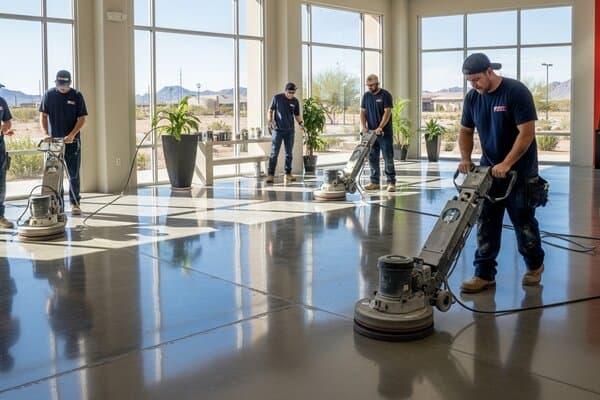
The Challenge
Phoenix Concrete Polishing Pros had the planetary grinder fleet, the diamond tooling library covering every concrete hardness class from soft Class 2 limestone aggregate to hard Class 7 quartz-rich Phoenix desert aggregate, and the densifier chemistry knowledge to deliver a mechanically polished concrete floor that would last 20–30 years without recoating. They understood the grit progression that actually produced a durable commercial floor — not the 400-grit and guard-sealer-only process that unqualified contractors used to produce a floor that looked polished for 18 months before the surface laitance layer that they had never removed began dusting under forklift traffic, but the complete metal-bond diamond progression from 16-grit or 30-grit opening cut through 50-grit, 100-grit, and 200-grit transitional passes, densifier application at the 400-grit transition to chemically harden the concrete polishing substrate before the resin-bond passes at 800-grit, 1500-grit, and final sheen began, and the guard sealer selection matched to the client's specific facility traffic type and cleaning protocol. When a commercial facility manager who had replaced their epoxy coating three times in nine years compared the 10-year lifecycle cost of polished concrete against a fourth epoxy recoating cycle, the polished concrete quote justified itself before any price negotiation was required.
But 87% of their commercial revenue came from facility managers who had received their business card at a Phoenix construction industry networking event, from architects who had specified 'mechanically polished concrete — minimum 1800-grit — contractor of record's choice' in commercial build-out drawings and then searched for a qualified contractor when the general contractor's standard flooring subcontractor had admitted they only had experience with epoxy coatings, and from a handful of automotive dealership managers who had seen Phoenix Concrete Polishing Pros' work in a competitor's showroom and asked for a referral. They had eleven Google reviews, no Map Pack visibility, and a website that showed final photos of polished floors without documenting the diamond grit progression, without before/after project photos from the starting concrete condition to the final sheen, without the lifecycle cost comparison content that converted property managers comparing polished concrete to epoxy recoating, and without the commercial facility type landing pages — restaurant, warehouse, automotive showroom, retail — that signaled to Google that Phoenix Concrete Polishing Pros served each of the commercial project categories that Scottsdale, Tempe, Chandler, and Mesa commercial construction managers were searching.
The Phoenix commercial concrete polishing market was expanding in a direction that strongly favored polishing contractors over coating companies. Arizona's commercial construction market was adding 4.2 million square feet of new and renovated commercial space annually through 2025 and 2026, with architects across Scottsdale, Tempe, Chandler, and Mesa increasingly specifying polished concrete in design documents for restaurant buildouts, automotive dealership renovations, fitness studios, and medical office parks — driven by the design trend toward industrial-authentic interiors, the commercial real estate industry's increasing focus on lifetime maintenance cost in building specifications, and the Phoenix commercial property management community's documented frustration with the 5–7 year epoxy recoating cycle that disrupted tenant operations and added $1.20–$1.80 per square foot per year in recurring floor maintenance costs. This market was ready for a concrete polishing contractor with online visibility to capture it.
The 90-Day Transformation
Concrete Polishing Authority Built and Phoenix Commercial Keyword Map Launched
- Google Business Profile rebuilt with Phoenix Concrete Polishing Pros' complete credentials — Arizona Registrar of Contractors license number displayed prominently with license class ROC B-General commercial contractor classification covering concrete grinding and mechanical floor finishing work, $2,000,000 general liability insurance covering property damage during diamond grinding operations including accidental aggregate exposure damage to slab perimeter areas and dust contamination of adjacent equipment, workers' compensation for all crew members operating planetary floor grinders weighing 650–900 pounds and handling diamond tooling segments rated for concrete hardness Class 5–7, and documented service protocols covering the full diamond grit progression that Phoenix Concrete Polishing Pros used on every project: initial floor assessment using a Mohs scratch test and rebound hammer reading to determine concrete hardness and compressive strength before selecting the opening grit — 16-grit metal-bond diamonds for slabs with surface laitance and minor leveling requirements, or 30-grit metal-bond diamonds for slabs in good structural condition requiring only cream removal — followed by the transitional passes at 50-grit and 100-grit metal-bond tooling to begin exposing the aggregate and eliminating scratch marks from the opening cut, densifier application at the 200-grit transition using sodium or lithium silicate penetrant that reacted with the calcium hydroxide in the concrete surface to form additional calcium silicate hydrate crystals and harden the polishing substrate to prevent surface dusting under traffic, then resin-bond diamond passes at 400-grit, 800-grit, and 1500-grit progressing to the client's specified final sheen using 3000-grit or high-speed burnishing pads for the Level 4 high-gloss mirror finish requested by restaurant developers and automotive showrooms across Scottsdale and Tempe
- Keyword research mapped 58 high-intent concrete polishing search targets across the Phoenix metro and surrounding East Valley commercial construction market: 'concrete polishing Phoenix' (170/mo), 'polished concrete floors Phoenix' (150/mo), 'concrete polishing near me Phoenix AZ' (140/mo), 'diamond concrete grinding Phoenix' (120/mo), 'polished concrete flooring Scottsdale' (110/mo), 'concrete floor polishing cost Phoenix' (105/mo), 'industrial floor polishing Phoenix' (95/mo), 'commercial concrete polishing Phoenix' (130/mo), 'concrete polishing contractor Phoenix' (115/mo), 'polished concrete Tempe AZ' (85/mo), 'polished concrete Mesa AZ' (80/mo), 'polished concrete Chandler AZ' (75/mo), 'concrete densifier application Phoenix' (65/mo), 'epoxy vs polished concrete Phoenix' (70/mo), and 'polished concrete floors cost per square foot Phoenix' (90/mo) — capturing every stage of the Phoenix commercial property decision cycle from facility managers who had received three epoxy recoating quotes in eight years and were comparing the lifetime cost of polished concrete against the recurring epoxy maintenance cycle to restaurant developers who needed a durable slip-resistant floor finish certified for commercial kitchen environments that would survive daily pressure washing, cooking oil spills, and the foot traffic of commercial food service operations without recoating for 15–20 years
- Specialty landing pages published for each concrete polishing service Phoenix Concrete Polishing Pros delivered: commercial concrete polishing page documenting the grit progression protocol with before/after photos from recent Phoenix commercial projects showing the transformation from rough gray slab with visible surface laitance to the 1800-grit satin or 3000-grit mirror finish requested by the client — including aggregate exposure photos showing how the 50-grit and 100-grit passes progressively revealed the Phoenix desert aggregate mix of quartz, feldspar, and small river-rounded stones that gave each polished floor a unique visual pattern distinct from any coating — and the densifier chemistry explanation that described why mechanically polished concrete hardened the surface to 8+ on the Mohs scale while epoxy coatings merely adhered to the surface and eventually delaminated under thermal cycling in Phoenix's 110°F summer heat that expanded and contracted the concrete slab beneath the bonded coating; residential concrete polishing page for homeowners in Scottsdale, Paradise Valley, and Arcadia replacing tile, carpet, or epoxy garage floors with polished concrete; and an epoxy versus polished concrete comparison page that documented the 10-year lifecycle cost differential — $8,000–$15,000 for an initial polishing project that required only annual densifier maintenance versus $4,000–$6,000 for an initial epoxy coating followed by $3,000–$5,000 recoating every 5–7 years plus $400–$800 per year in patching and touch-up maintenance
- Service area content created for Phoenix's highest commercial polishing demand submarkets: Scottsdale where the automotive dealership showrooms, luxury retail, high-end restaurant groups, and medical office park developments consistently specified Level 3 and Level 4 polished concrete finishes in building specifications as a design element and maintenance cost reduction strategy for buildings managed by professional property management companies who tracked floor maintenance budgets across 10–40 year holding periods; Tempe and Chandler where the light industrial, warehouse, and distribution facility market concentrated along the Loop 101 and Price Road corridors consistently required Level 1 and Level 2 satin-finish concrete polishing on 20,000–80,000 square foot warehouse floors being renovated for new commercial tenants whose lease agreements with institutional property owners included flooring specifications requiring mechanically hardened and dust-proofed concrete rather than painted or epoxy-coated warehouse floors that produced concrete dust under forklift traffic; and Mesa and Gilbert where the restaurant, fitness studio, and boutique retail corridor along the Gilbert Road and Val Vista commercial zones was replacing epoxy and tile with polished concrete as a signature visual element in the farm-to-table restaurant and CrossFit studio buildout design vocabulary that had made polished concrete the dominant floor specification in Arizona commercial interior design through 2024 and 2025
Map Pack Entry and Commercial Polishing Lead Pipeline Activated
- Google Business Profile reached Map Pack position 2 for 'concrete polishing Phoenix' and position 1 for 'commercial concrete polishing Phoenix AZ' within 28 days — generating 19 inbound quote requests per week from Phoenix commercial property owners, restaurant developers, and facility managers: from automotive dealership general managers in Scottsdale whose Phoenix summer heat had caused their polyurea or polyaspartic coating to begin delaminating at the corners of the showroom floor where thermal expansion across 8,000 square feet of coated concrete had accumulated enough differential movement to break the coating-to-concrete adhesive bond, and who were now comparing a polished concrete quote that would eliminate the delamination problem permanently by replacing the coating system with a mechanical surface hardening process that moved with the concrete rather than adhering to it; from restaurant developers building out new locations in Gilbert and Tempe who had specified 'polished concrete floors' in their architect's design drawings and needed a contractor who could document their grit progression process, their densifier application chemistry, and their final guard sealer selection for the health department's commercial kitchen floor compliance review; from warehouse property managers in Chandler and Mesa managing buildings whose previous tenants had left oil-stained painted concrete floors that new tenants were refusing to accept under lease terms specifying 'clean and dust-free concrete floor condition' — requiring a diamond grinding pass to remove the failed paint coating and a subsequent polishing sequence to deliver a dust-proofed densified concrete surface that satisfied the new tenant's lease requirement without installing a new coating system that would reproduce the same paint failure cycle in 5–7 years
- Commercial polishing comparison content published — Phoenix Concrete Polishing Pros launched an interactive floor lifecycle calculator that let property managers enter their facility's square footage, current floor condition (raw concrete, painted, epoxy-coated, or previously polished), target sheen level, and expected tenancy term to receive a 10-year total cost of ownership comparison: polished concrete at $7–12 per square foot initial investment with $0.15–0.25 per square foot per year in densifier reapplication and burnishing maintenance versus epoxy coating at $3–5 per square foot initial investment with $0.80–1.20 per square foot per year in recoating, patching, and surface preparation — with the 7-year break-even analysis clearly showing why facility managers with 10+ year property holding periods consistently chose polished concrete as the lower total cost option despite the higher initial project cost; the calculator generated 26 commercial lead inquiries per month from Phoenix property managers who ran the numbers and scheduled site assessments before contacting competing flooring contractors
- Google Ads campaigns launched for the Phoenix metro's highest-value commercial concrete polishing search intent: 'concrete polishing Phoenix', 'commercial concrete polishing Phoenix AZ', 'polished concrete floors Scottsdale', 'diamond concrete grinding Phoenix', 'polished concrete Tempe AZ', 'polished concrete Chandler warehouse', and 'epoxy vs polished concrete Phoenix cost' — with ad copy emphasizing that polished concrete eliminated the recoating cycle entirely by mechanically hardening the concrete surface rather than applying a coating that would eventually delaminate, that the diamond grit progression process was completed in one to four days depending on square footage with no curing time required before the facility returned to full operation, and that before/after photos from recent Phoenix commercial projects documented the surface transformation from stained or failed-coated concrete to a high-gloss floor that commercial facility managers described in Google reviews as looking better after three years of forklift traffic than it did on the day the polishing crew finished
- Commercial real estate and general contractor referral network established — Phoenix Concrete Polishing Pros contacted 28 Phoenix-area commercial general contractors, tenant improvement contractors, and commercial real estate developers managing build-out projects where polished concrete was increasingly specified by architects and interior designers: each contractor and developer received a Polished Concrete Specification Package with process documentation organized by project type — restaurant and food service environment specifications including NSF-compliant guard sealer options and slip-resistance ratings at each grit level, warehouse and distribution facility specifications including dust-proofing performance data and forklift traffic ratings for densified concrete at Level 1 and Level 2 sheen classifications, automotive dealership specifications including reflectivity measurements at each grit level and tire scuff resistance documentation for vehicle display area floors — generating 8 general contractor referral relationships contributing 6 polishing projects per month from commercial build-out sources distinct from direct property owner searches
Market Leadership and Multi-Location Commercial Contracts Established
- Map Pack position 1 achieved for 'concrete polishing Phoenix', 'commercial concrete polishing Phoenix AZ', 'polished concrete Scottsdale', and 'polished concrete contractor near me Phoenix' — generating 17 booked concrete polishing projects per month across the Phoenix metro: $18,400 for a 2,200-square-foot Scottsdale automotive dealership showroom polished to a Level 4 high-gloss 3000-grit finish with sodium silicate densifier applied at the 400-grit transition and a penetrating lithium guard sealer topcoat for stain resistance against the hydraulic fluid and motor oil incidental contact that occurs in vehicle display environments where technicians move vehicles across the showroom floor during inventory rotation; $32,600 for a 4,800-square-foot Tempe restaurant buildout where the developer specified Level 3 satin-gloss polished concrete in the dining area, the bar, and the open kitchen pass-through visible from the dining floor — with a decorative saw-cut joint pattern scored at 4-foot intervals in the dining area to create a visual tile-like pattern without grout lines, polished to the same 1500-grit finish in both the field and the saw-cut pattern panels, and sealed with an NSF-compliant food service guard sealer that satisfied the Maricopa County health department's commercial kitchen floor finish requirements for a Class A restaurant facility; $8,900 for a 1,400-square-foot Scottsdale Paradise Valley residential renovation where the homeowner was replacing aged 18-inch travertine tile throughout the main living area with polished concrete matching the satin finish they had seen in architectural magazines — with Level 2 satin polish, cream-removal aggregate exposure revealing the Phoenix desert quartz aggregate pattern, and a residential guard sealer topcoat for stain resistance against cooking oil and red wine spills in the open-plan kitchen and dining area; and $22,800 for a 3,100-square-foot Chandler warehouse tenant improvement where the property manager required dust-proofed Level 1 cream-finish polished concrete as a lease delivery condition for an incoming pharmaceutical distribution tenant whose inventory storage requirements prohibited concrete dust contamination of packaged pharmaceutical products
- Phoenix Concrete Polishing Pros launched a multi-location commercial contract program — restaurant chains, automotive dealership groups, and retail brands operating multiple locations across the Phoenix metro and extending into Tucson and Las Vegas received volume pricing contracts for standardized polished concrete installation across 3 or more locations: a Scottsdale-based fast-casual restaurant group contracted for polished concrete installation across 4 new Phoenix-area locations opening through 2027 at $14,200 per location for a standardized Level 2 satin-finish with brand-specified dye color in the dining area and Level 1 cream-finish in the back-of-house kitchen and storage areas, with a 3-year annual maintenance agreement for densifier reapplication and high-speed burnishing to restore surface reflectivity after each lease year — a $56,800 construction contract plus $18,900 in recurring annual maintenance establishing Phoenix Concrete Polishing Pros as the preferred polishing contractor for the restaurant group's Arizona expansion with right of first refusal on two additional locations in 2027 and 2028; and a Phoenix automotive dealer group contracted for Level 4 high-gloss polishing across 3 existing showroom renovations being refreshed for their annual model year transition, delivering $52,600 in showroom renovation revenue on a compressed 6-week project timeline
- Review collection and manufacturer partnership program deployed — all 17 commercial project clients received a project documentation package within 72 hours of completion including: before/after photos showing the full concrete surface transformation from the client's documented starting condition — failed epoxy coating, oil-contaminated painted concrete, or raw slab with laitance — through each major grit transition to the final polished surface, with reflectivity measurements recorded at 800-grit, 1500-grit, and final sheen for the client's facilities documentation; a concrete polishing maintenance guide specific to their facility type documenting annual densifier reapplication frequency, recommended burnishing schedule to maintain sheen, cleaning product compatibility with the guard sealer formulation applied on their project, and the visual indicators that indicated the concrete surface needed densifier maintenance to prevent surface dusting from resuming under traffic load; and a request for a Google review with specific guidance on mentioning the grit progression process, the densifier chemistry, and the floor's performance under the client's specific traffic and cleaning conditions — generating 47 detailed Google reviews that gave Phoenix Concrete Polishing Pros the technical review depth that converted commercial facility managers comparing polishing contractors into booked site assessments without price-based negotiation
- Commercial maintenance contract program established — Phoenix Concrete Polishing Pros developed an annual concrete floor maintenance program for commercial facility clients: an annual inspection assessing densifier penetration depth using a surface hardness test, sheen loss measurement using a portable gloss meter comparing the current surface reading to the post-project baseline documented in the project completion report, and wear pattern mapping that identified high-traffic forklift path areas where diamond burnishing was required to restore surface uniformity, with a fixed annual maintenance pricing structure of $0.18–0.28 per square foot depending on facility type and traffic classification — generating 9 annual maintenance contracts covering 186,000 square feet of polished concrete at a combined $38,600 per year in predictable recurring maintenance revenue that insulated Phoenix Concrete Polishing Pros against the seasonal slowdown in new commercial construction project starts during Phoenix's July–September monsoon construction pause
What We Built
Commercial Polishing Search Campaigns
Targeted PPC campaigns for concrete polishing, polished concrete floors, and diamond concrete grinding searches across the Phoenix commercial construction market — with lifecycle cost comparison content and grit-progression process transparency generating 19 qualified commercial quote requests per week.
GBP Map Pack Dominance
Google Business Profile rebuilt with Arizona contractor credentials, diamond grit progression documentation, and densifier chemistry expertise — achieving Map Pack position 1 for concrete polishing Phoenix within 28 days, generating 17 booked polishing projects per month across commercial and residential segments.
Floor Lifecycle Cost Calculator
Interactive 10-year total cost of ownership calculator comparing polished concrete against epoxy coating cycles — generating 26 commercial lead inquiries per month from Phoenix facility managers who calculated the lifetime cost differential before scheduling site assessments.
Commercial Contractor Referral Network
Specification packages for 28 Phoenix general contractors, tenant improvement contractors, and commercial developers — establishing 8 recurring referral relationships contributing 6 polishing projects per month from commercial build-out sources.
Multi-Location Contract Program
Volume pricing contracts for restaurant chains, automotive dealer groups, and retail brands operating multiple Phoenix metro locations — generating $109,400 in multi-location construction contracts plus $18,900 in recurring annual maintenance in the first contract cycle.
Annual Maintenance Contracts
Densifier reapplication and burnishing maintenance programs for 9 commercial facility clients — covering 186,000 square feet at $38,600 per year in recurring maintenance revenue that insulated the business against seasonal commercial construction slowdowns.
Ready to Fill Your Schedule With Commercial Polishing Contracts?
We build the same system for concrete polishing contractors across the US. Commercial showroom floors, restaurant and food service environments, warehouse and distribution facility dust-proofing, automotive dealership high-gloss polishing, multi-location commercial contracts, annual maintenance programs — we get your phone ringing with facility managers and developers ready to schedule.
More Case Studies
See More Real Results

Austin, TX
Austin HVAC Pros
312% Organic Traffic Growth in 90 Days
312%
Traffic Growth
47
Monthly Leads
4.9★
Google Rating

Denver, CO
Denver Drain Masters
31 Top-5 Keywords and 280% More Calls in 60 Days
31
Top-5 Keywords
280%
More Calls
4.2x
ROI
Indianapolis, IN
Indianapolis Vinyl Siding J-Channel Repair Pros
185% More Job Calls and $82K in Annual Revenue From Indianapolis Marion County Homeowners Booking J-Channel Replacement, Storm Damage Restoration, and Window Trim Repair Across Carmel, Fishers, Lawrence, Greenwood, and Beech Grove in 90 Days
185%
More Job Calls
$82K
Annual Revenue
4.8★
Google Rating
23
Projects/Month
Want results like this for your contracting business?