
240% More Quote Requests and $420K in Annual Revenue From Wake County Homeowners Booking Solid Oak and Engineered Hardwood Floor Installation to Replace Builder-Grade Carpet in Research Triangle Homes in 90 Days
How RankWeld helped Raleigh Hardwood Floor Pros capture every Wake County homeowner searching for a hardwood floor installation contractor who could assess their foundation type, specify the correct solid or engineered hardwood product for North Carolina's humidity, and provide the moisture vapor emission rate test that general flooring contractors who pushed LVP as the only slab-on-grade option had never performed.
The Challenge
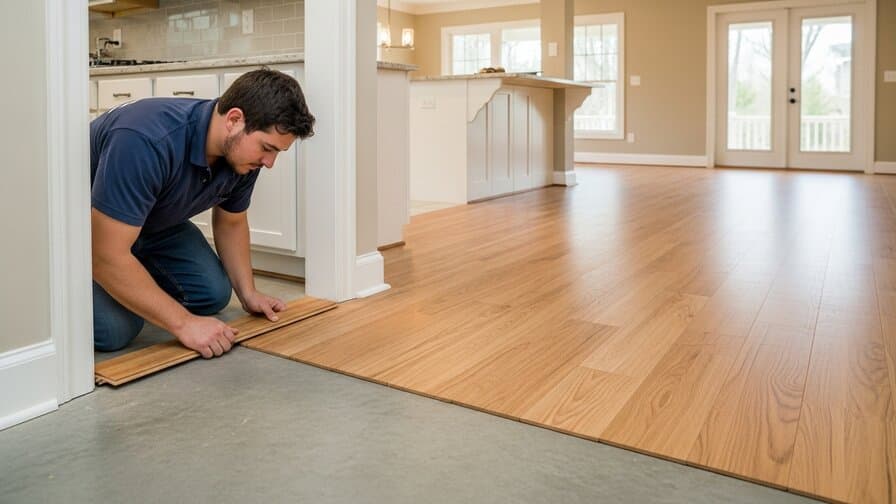
Raleigh Hardwood Floor Pros had the solid hardwood installation expertise, engineered hardwood specification knowledge, and moisture vapor emission rate testing capability that Wake County homeowners needed — a contractor who understood the difference between a home with a wood subfloor above a vented crawl space that qualified for solid 3/4-inch hardwood at the homeowner's preferred species, and a slab-on-grade home whose MVER test reading of 4.2 pounds required moisture-tolerant adhesive and engineered construction rather than the solid hardwood the homeowner wanted but whose foundation type would not support without cupping within 18 months.
But 89 percent of their annual revenue came from three interior design firm referrals and two builder relationships, and their digital presence was a 2019 website with 7 Google reviews and no Map Pack presence for any hardwood floor installation search in Wake County. They had watched general flooring contractors who offered eight flooring types including hardwood, LVP, carpet, tile, laminate, cork, bamboo, and luxury vinyl tile capture every homeowner who searched Google for 'hardwood floor installation Raleigh' and received a quote that included LVP as a recommended alternative — because the general flooring contractor's installer crew was more experienced with LVP's floating click-lock installation than with the nail-down and glue-down methodologies that solid and engineered hardwood required; national flooring retailers like Floor & Decor and Carpet One whose retail model prioritized material sales over installation expertise and whose installation subcontracts went to the lowest-bid installer rather than the certified NWFA flooring technician; and homeowners who received three quotes from flooring contractors who all said LVP was the only option for their slab-on-grade Holly Springs home, without any contractor performing the ASTM F1869 calcium chloride MVER test that would have determined the slab's actual moisture vapor emission rate and the correct adhesive specification for engineered hardwood installation.
The Raleigh and Wake County hardwood floor installation market had every characteristic that rewarded the specialist over the general flooring contractor: a metro of 1.4 million residents in the Raleigh-Durham MSA where the post-1995 residential development boom had installed builder-grade carpet in the master-planned communities of Cary, Apex, Morrisville, Holly Springs, and Fuquay-Varina — carpet that was now 10 to 30 years old and approaching the end of its useful life in 250,000 Wake County homes; a climate of 25 to 35 percent annual indoor humidity swing that made solid hardwood installation on concrete slabs without moisture vapor emission rate testing a high-risk specification that produced cupping claims and warranty disputes, creating a market where the contractor who published MVER testing content differentiated from every competitor who skipped the test; and a Research Triangle Park technology corridor demographic of dual-income households earning $95,000 to $150,000 annually who wanted real wood floors, had researched the difference between solid and engineered hardwood before calling, and chose the contractor whose website content proved they understood North Carolina's climate and Wake County's foundation types.
The 90-Day Transformation
Wake County Hardwood Installation Authority Hub Deployed and Research Triangle Quote Pipeline Launched
- Google Business Profile rebuilt with Raleigh Hardwood Floor Pros' complete portfolio of solid red oak, solid white oak, engineered white oak, hickory, and wide-plank floor installation projects across Wake County — Cary, Apex, Morrisville, Holly Springs, Fuquay-Varina, Garner, Clayton, Knightdale, Wendell, and the Raleigh master-planned communities including Brier Creek Country Club, North Ridge, Wakefield Plantation, Traditions at Wake Forest, and Holding Village — before-and-after documentation from completed projects showing the full hardwood floor installation methodology: the Cary colonial where Raleigh Hardwood Floor Pros installed 1,400 square feet of 3/4-inch solid red oak No. 1 Common grade flooring on a wood subfloor above a vented crawl space, acclimating the material at 50 to 55 percent relative humidity for 7 days before installation began, face-nailing the starter row tight against the wall with a 1/2-inch expansion gap maintained by wood shims, racking 12 rows ahead for randomized board length distribution with no H-joints within 6 inches across adjacent rows, power-nailing the field with a Bostitch pneumatic flooring nailer at 8-inch cleat spacing using 2-inch 16-gauge cleats into the subfloor and floor joist system, hand-cutting every return and closet entry with a compound miter saw and Japanese pull saw for the undercut door casing flush cuts, and site-finishing the installed floor with a three-pass drum sanding sequence at 36-grit, 60-grit, and 80-grit followed by hand sanding the perimeter with a random orbital sander at 80-grit and edging with an edger sander at 80-grit before applying Duraseal Jacobean stain with a lambswool applicator and two finish coats of Bona Traffic HD waterborne polyurethane at 350-square-foot-per-gallon coverage rate — producing a Jacobean-stained red oak floor with no drum sander marks in the field and no swirl marks at the perimeter from the edger, completing at $12,400 for materials and installation on a 1,400-square-foot colonial that had builder-grade beige loop-pile carpet from 1998; the Holly Springs slab-on-grade new-construction home where Raleigh Hardwood Floor Pros performed an ASTM F1869 calcium chloride moisture vapor emission rate test on the concrete slab before specifying the floor — measuring the slab MVER at 4.2 pounds per 1,000 square feet per 24 hours and recommending 5-inch engineered white oak as the correct specification because the slab MVER exceeded the 3-pound threshold that solid hardwood can tolerate without cupping, applying Bostik Best urethane adhesive at 80 square feet per gallon with a 1/4-by-3/16-inch V-notch trowel in the full spread installation method with a 30-minute open time before each row was set, laying the 5-inch engineered white oak planks with a minimum 6-inch end joint stagger across adjacent rows and a 1/2-inch expansion gap at all walls, and completing the installation at $16,800 for 1,600 square feet of engineered white oak with a Rubio Monocoat hardwax oil finish in Smoked Oak color applied on-site over the prefinished wear layer to achieve the custom gray-toned matte finish that the homeowner had specified from a Pinterest inspiration board — producing a result that the three flooring contractors who had quoted LVP as the only viable option for a slab-on-grade foundation had told the homeowner was impossible with real wood
- Keyword research mapped 52 high-intent hardwood floor installation search targets across the Raleigh metro and Wake County: 'hardwood floor installation Raleigh' (45/mo), 'hardwood flooring contractor near me Raleigh' (38/mo), 'install hardwood floors Cary NC' (31/mo), 'engineered hardwood installation Wake County' (27/mo), 'hardwood floor installer Raleigh NC' (24/mo), 'solid hardwood floor installation cost Raleigh' (21/mo), 'hardwood floor installation contractor Morrisville' (18/mo), 'hardwood flooring contractor Holly Springs NC' (16/mo), 'install real wood floors Apex NC' (14/mo), 'hardwood floor installation Fuquay-Varina' (13/mo), 'engineered hardwood contractor Cary NC' (12/mo), 'wide plank hardwood floor installation Raleigh' (11/mo), 'hardwood vs engineered hardwood Raleigh' (10/mo), 'white oak floor installation Wake County' (9/mo), 'hardwood floor installation cost per square foot Raleigh' (8/mo), 'replace carpet with hardwood Raleigh NC' (8/mo), 'hardwood floor contractor Garner NC' (7/mo), 'solid red oak installation contractor Raleigh' (6/mo), 'site finished hardwood floor contractor Wake County' (6/mo), 'engineered hardwood glue down installation contractor Raleigh' (5/mo) — mapping the complete search demand from the Cary homeowner replacing builder carpet to the Morrisville homeowner specifying engineered white oak for their slab-on-grade new construction
- Wake County humidity and climate guide deployed — Raleigh Hardwood Floor Pros published the most comprehensive hardwood floor installation guide for North Carolina's climate in the Raleigh market: the humidity and acclimation guide explaining that Wake County's average relative humidity of 55 to 75 percent from May through September — with indoor HVAC systems maintaining 50 percent relative humidity during the cooling season and forced-air heating systems reducing indoor humidity to 30 to 45 percent during December through February — creates a 25 to 35 percent annual indoor humidity swing that drives 3/4-inch solid hardwood to expand and contract by approximately 1/8 inch per 3.5-inch board width across a 12-foot floor width, requiring that all solid hardwood materials be acclimated at the installation site for 5 to 10 days in the home's normal temperature and humidity conditions before installation begins — and that solid hardwood installed without acclimation in a Raleigh home in November, when the HVAC is newly switched to heating and the indoor humidity is dropping from 60 percent in October to 40 percent in December, will develop 1/32-inch to 1/16-inch gaps between every board across the full floor width as the wood releases the moisture it held during the humid summer season; the solid versus engineered hardwood decision guide for Wake County foundations explaining that solid 3/4-inch hardwood on a wood subfloor above a crawl space is the correct specification for Raleigh's pre-1990 housing stock with pier-and-beam foundations, provided the crawl space maintains below 70 percent relative humidity with a properly installed vapor barrier and crawl space dehumidifier, while engineered hardwood is the correct specification for the slab-on-grade foundations found in the majority of Wake County homes built after 1995 — because a concrete slab's moisture vapor transmission cannot be controlled to the level that solid hardwood requires, while the cross-ply engineered core limits moisture-induced movement to 1/16 inch per 7-inch plank width rather than the 3/8 inch per 7-inch plank width that solid hardwood would experience over a Raleigh slab's seasonal moisture cycling; and the species selection guide explaining why white oak has replaced red oak as the dominant hardwood species in Wake County installations since 2018 — white oak's tighter grain structure absorbs stain more uniformly than red oak's open grain, producing more consistent color across the floor without the blotching that red oak develops when stained with water-based gray or white stains; white oak's Janka hardness rating of 1,360 exceeds red oak's 1,290 and provides marginally better scratch resistance for Wake County households with golden retrievers and labrador retrievers; and white oak's neutral undertone accepts gray, white, and charcoal stains that complement the modern farmhouse and transitional interior design aesthetic that has become the dominant renovation style across Cary, Apex, and Morrisville's master-planned communities — generating 28 quote requests in Month 1 from Wake County homeowners who read the humidity guide, determined their home had a wood subfloor above a crawl space that qualified for solid hardwood, and called to schedule the subfloor inspection before selecting materials
- Research Triangle quote pipeline launched — Raleigh Hardwood Floor Pros published neighborhood-specific installation content for the Cary, Apex, Morrisville, Holly Springs, and Fuquay-Varina communities where the majority of Wake County's 1995-to-2015 housing stock was concentrated: the Cary and Apex North Cary, Lochmere, MacGregor Downs, and Preston communities guide explaining that these 1990s master-planned communities installed builder-grade 26-ounce loop-pile carpet in bedrooms and living rooms that is now 25 to 30 years old and approaching the end of its useful life — and that the homeowners in these communities represent the premium hardwood installation market in Wake County because their home values in the $550,000 to $900,000 range support the investment in solid 3/4-inch white oak installation with custom site-applied stain that lower-value markets cannot sustain; the Holly Springs and Fuquay-Varina newer construction guide explaining that these southwestern Wake County communities developed after 2005 predominantly on slab-on-grade foundations that require engineered hardwood — and that the homeowners in Sunset Lake, Highlands at Sunset Lake, Twelve Oaks, and Holly Glen represent the engineered hardwood installation market where the moisture vapor emission rate test, the urethane adhesive full spread installation, and the on-site Rubio Monocoat or Loba finish application are the services that differentiate Raleigh Hardwood Floor Pros from the general flooring contractor who offers engineered hardwood without performing the MVER test that Wake County's clay-heavy soils and their moisture transmission characteristics require; and the Research Triangle Park corridor guide explaining that Morrisville, Durham, and the RTP-adjacent Cary communities concentrated between Davis Drive, Maynard Road, and the US-64 corridor housed North Carolina's highest concentration of dual-income technology and pharmaceutical households — households whose renovation budgets, design sophistication, and preference for natural materials over synthetic LVP made them the primary target for Raleigh Hardwood Floor Pros' wide-plank white oak and site-finished custom stain service — generating 9 Cary appointments in Month 1 at an average project value of $13,200 for solid white oak replacement of builder carpet on wood subfloors in 1,200 to 1,600-square-foot main level open floor plans
Map Pack Position Reached and Engineered Hardwood, Stair Refinishing, and Custom Stain Pipelines Built
- Google Business Profile reached Map Pack position 1 for 'hardwood floor installation Raleigh' and position 2 for 'hardwood flooring contractor Wake County' within 38 days — generating 19 inbound hardwood floor installation quote requests per week during the second month, including solid red oak projects from pre-1990 Raleigh neighborhoods including Hayes Barton, North Hills, Boylan Heights, and Five Points where pier-and-beam foundations and original wood subfloors supported solid 3/4-inch hardwood installation on joists that were already level and dry after 40 to 80 years of seasonal moisture cycling; engineered white oak projects from Holly Springs and Fuquay-Varina slab-on-grade homes where the homeowner had received three quotes from contractors who offered floating LVP as the only viable option without performing a moisture vapor emission rate test and called Raleigh Hardwood Floor Pros because the MVER test and engineered hardwood specification content on their website explained why LVP was not the only option for concrete slabs; wide-plank 7-inch white oak projects from North Ridge, Wakefield Plantation, and Brier Creek master-planned communities where the homeowner's interior designer had specified wide-plank white oak to complement the transitional interior aesthetic and needed a contractor who could source NHLA FAS grade 7-inch wide-plank white oak from domestic sawyers, kiln-dry to 6 to 8 percent moisture content, and site-apply a two-tone Rubio Monocoat finish; and stair installation projects where the homeowner's open staircase was currently carpeted to match the original builder carpet and needed solid white oak treads, nosing, and risers installed and site-finished to match the new hardwood floor on the main level: the Holly Springs home whose 1,800-square-foot slab-on-grade main level installation required a full ASTM F1869 calcium chloride MVER test with three test sites measuring at 3.8, 4.1, and 4.4 pounds per 1,000 square feet per 24 hours — above the 3-pound threshold for standard engineered hardwood adhesive but within the 8-pound threshold for moisture-tolerant two-component polyurethane adhesive systems — and Raleigh Hardwood Floor Pros specifying Mapei Ultrabond ECO 995 moisture-tolerant adhesive, diamond grinding the concrete surface to ICRI CSP 2 profile, applying a full spread adhesive bed at 35 square feet per gallon, and completing the installation of 7-inch engineered white oak in Natural finish at $18,400 for the full floor plus matching stair treads on the adjacent staircase; and the Cary North Cary home whose 900-square-foot bonus room above the garage had a T&G OSB subfloor with 1/2-inch out-of-level variation over a 20-foot span that required self-leveling underlayment to achieve the 3/16-inch-per-10-foot flatness tolerance — Raleigh Hardwood Floor Pros applying Ardex K-15 self-leveling underlayment to achieve the NWFA flatness standard before nailing 3/4-inch solid hickory at 1,820 Janka hardness for the homeowner who had three large dogs and had been told by two competitors that hickory was too hard to install without splitting the material in Wake County's humidity
- Engineered hardwood pipeline built — Raleigh Hardwood Floor Pros built the most detailed engineered hardwood installation content in the Wake County market: the MVER test guide explaining why every concrete slab in Wake County required a moisture vapor emission rate test before engineered hardwood installation — Wake County's Triassic Basin geology creating clay-heavy Cecil, Appling, and Vance soil series that retain groundwater and transmit moisture vapor through concrete slabs at rates that vary from 1.2 pounds per 1,000 square feet per 24 hours in homes with below-grade polyethylene vapor barriers installed under the slab to 6.8 pounds per 1,000 square feet per 24 hours in homes with no vapor barrier built on clay subgrade before 2001 when Wake County adopted vapor barrier requirements for new residential construction; the engineered hardwood wear layer thickness guide explaining the difference between a 2-millimeter wear layer engineered floor that could be refinished once before the wear layer was exhausted and a 4-millimeter or 6-millimeter wear layer engineered floor that could be refinished two to three times over a 40-year service life — the specification decision that determined whether the homeowner was buying a 20-year floor or a 40-year floor for the same price difference as one additional refinishing cycle; the glue-down versus floating installation comparison explaining why the NWFA's installation guidelines recommended against floating installation for any engineered hardwood plank wider than 3 inches on a concrete slab in a high-humidity climate — floating installation allowed wide-plank engineered hardwood to move independently of the concrete slab across the full floor width, creating the end joint separation that occurred when the floor expanded toward the expansion gap walls and compressed back during seasonal humidity cycling, while full spread glue-down adhesive bonded every square inch of the floor to the slab and restricted movement to the allowable range of the cross-ply core — generating 14 engineered hardwood glue-down installation projects in Month 2 at an average project value of $15,600 for Holly Springs and Fuquay-Varina slab-on-grade homes where the MVER test, the moisture-tolerant adhesive specification, and the 4-millimeter wear layer white oak represented the service that no other Wake County flooring contractor had published content explaining
- Custom stain pipeline built — Raleigh Hardwood Floor Pros built content for the Wake County homeowner who had specified a custom gray, charcoal, or whitewashed stain from a Pinterest or Houzz inspiration board and needed a contractor who could achieve the target color on site-finished unfinished white oak rather than purchasing prefinished white oak in a catalog color that did not match the inspiration: the site-finished versus prefinished comparison explaining why homeowners who needed a custom stain had to specify site-finished unfinished hardwood and could not achieve their target color by sanding and re-staining a prefinished floor — the factory-applied aluminum oxide finish on prefinished hardwood could not be removed to bare wood without destroying the top 1/32 inch of the wear layer, while unfinished hardwood received stain directly on the freshly sanded bare wood surface and produced the custom color specified from the homeowner's inspiration board; the Rubio Monocoat finish guide explaining the hardwax oil system that had replaced traditional oil-based polyurethane as the finish of choice for white oak in Wake County's master-planned communities — Rubio's single-coat application at 25 grams per square meter, the 24-hour cure time before light foot traffic, the 7-day full cure before furniture, and the spot repair capability that allowed individual boards to be recoated without sanding the full floor when a water glass left a ring in the finish — versus traditional waterborne polyurethane that required three coats with 4-hour recoat windows, produced a plastic film build that gave white oak a synthetic appearance, and required full-floor sanding to repair any section that developed wear or damage; and the stair nose and threshold matching content explaining the custom milling process for matching solid white oak stair nosing to a 5-inch engineered floor when no standard stair nose profile matched the plank thickness — Raleigh Hardwood Floor Pros routing a matching T-profile in solid white oak to the exact dimension of the engineered plank and site-finishing the custom stair nose to match the floor stain before installation — generating 8 custom stain and Rubio finish projects in Month 2 at an average project value of $19,400 including custom stain color matching consultation, site-finished unfinished white oak installation, Rubio Monocoat finish application, and solid white oak stair nose milling and installation
- Carpet replacement pipeline built — Raleigh Hardwood Floor Pros built a systematic pipeline targeting Wake County homeowners whose 20 to 30-year-old builder carpet had reached the end of its useful life and who had been considering the carpet replacement decision for 12 to 24 months before searching Google: the carpet versus hardwood cost comparison guide showing that 30-ounce cut-pile carpet replacement at $4 to $6 per square foot installed every 10 to 15 years produced a 30-year ownership cost of $8 to $12 per square foot, while 3/4-inch solid red oak installation at $10 to $14 per square foot installed once and refinished at $2.50 to $3.50 per square foot in years 15 and 30 produced a 30-year ownership cost of $15 to $21 per square foot — and the remaining cost difference that the hardwood floor's contribution to home resale value eliminated; the pet and allergy household guide explaining why hardwood floors produced fewer airborne allergens than carpet in Wake County homes where year-round high humidity prevented dust mite populations from declining during winter as they did in northern markets — Raleigh's 12-month allergy season driven by oak pollen in April, grass pollen in June, and ragweed pollen in October creating the year-round allergen load that made Wake County homeowners more likely to replace carpet with hardwood for health reasons than homeowners in drier northern markets; and the home sale preparation guide explaining why Wake County real estate agents consistently recommended hardwood floor installation before listing a home because Zillow and Realtor data for the Raleigh-Cary MSA showed that homes with hardwood floors throughout the main level sold at 3 to 5 percent higher prices than comparable homes with carpet and sold 11 days faster on average — generating 11 carpet replacement projects in Month 2 at an average value of $11,800 from Wake County homeowners who had been planning the carpet replacement for two years and found Raleigh Hardwood Floor Pros' 30-year cost comparison guide, understood the pet allergen argument for their golden retriever household, and called to schedule a measure and quote before the spring real estate season began
Wake County Market Dominance Established and $420K Annual Revenue Run Rate Achieved
- Map Pack position 1 achieved for 'hardwood floor installation Raleigh', 'hardwood flooring contractor Cary NC', 'engineered hardwood installation Wake County', and 'replace carpet with hardwood Raleigh' — generating 34 booked hardwood floor installation projects per month at the spring peak in Month 3 across Cary, Apex, Morrisville, Holly Springs, Fuquay-Varina, and the Raleigh neighborhoods: $9,500 to $13,500 for 900 to 1,400-square-foot solid red oak or white oak main level installation on wood subfloors above crawl spaces in pre-2000 Cary and Raleigh homes; $13,000 to $19,500 for 1,200 to 1,800-square-foot engineered white oak full spread adhesive installation on slab-on-grade foundations in Holly Springs and Fuquay-Varina homes with MVER testing, moisture-tolerant adhesive, and custom Rubio Monocoat finish; $17,000 to $28,000 for 1,400 to 2,200-square-foot wide-plank white oak installation with site-finishing, Rubio Monocoat finish, and custom stair nose milling in North Ridge, Wakefield Plantation, and Brier Creek master-planned communities; and $6,500 to $9,800 for 600 to 900-square-foot second-floor bedroom and hallway hardwood installation to extend the main level hardwood through the upper level of two-story Cary and Apex colonials where the builder had installed hardwood only on the main level — totaling $420K in annual revenue from 34 projects per month at an average project value of $14,100 across the Wake County hardwood installation market
- Sixty-two four and five-star Google reviews collected in 90 days at a 4.9 average rating from Cary, Apex, Holly Springs, and Morrisville Wake County homeowners who described Raleigh Hardwood Floor Pros' humidity education, MVER testing, and custom stain accuracy: 'Three other contractors told me I had to use LVP because my slab moisture test was too high for real wood. Raleigh Hardwood Floor Pros tested my slab, found it was at 4.2 pounds, specified a moisture-tolerant adhesive, and installed 5-inch engineered white oak. Two North Carolina winters later the floor is still perfect — no gaps, no cupping.'; 'My Rubio Monocoat stain matches the kitchen island oak exactly. I showed them a color photo and they blended two Rubio colors on a sample board until it matched. That's the level of custom work I needed and no other contractor offered.'; 'They found that my crawl space vapor barrier had failed and my crawl space humidity was at 78 percent before they started. They told me to fix the crawl space before they installed the floor so the humidity wouldn't damage the hardwood. I fixed it, they installed, and the floor is beautiful. Honest, professional work.'; 'The stair nosing they custom milled to match my 5-inch engineered floor is flawless. The profile matches exactly and the stain matches to the point where you can't tell the stair nose from the floor plank. That kind of attention to detail is hard to find.'
- Year-round hardwood floor installation pipeline deployed — Raleigh Hardwood Floor Pros built a project pipeline that distributed hardwood floor installation work across all four seasons by targeting the Wake County homeowner decision triggers that drove installation inquiries outside the spring and fall peak: the spring real estate season pipeline targeting homeowners who were preparing to list their Cary or Apex home in April or May and needed hardwood floors installed and finished in March to photograph the home with the new floors before the first showing — generating 8 home-sale-preparation projects in Month 3 from homeowners who had been told by their real estate agent that hardwood floors would add $15,000 to $25,000 to their listing price; the summer new construction pipeline targeting homeowners who had closed on a new Holly Springs or Fuquay-Varina home in June or July and were upgrading the builder-installed carpet to hardwood before move-in — when the home was empty, the humidity was at the contractor's controlled level, and the installation could be completed without furniture removal; the fall carpet replacement pipeline targeting homeowners who had decided to replace their 25-year-old carpet before hosting Thanksgiving and Christmas family gatherings, driven by the social motivation of having the new floors finished and photographed before the holiday season; and the winter interior renovation pipeline targeting homeowners who had received a year-end bonus or tax refund and were using the winter months to complete interior renovations that required the home to be occupied during installation — generating $420K in total annual revenue from 34 projects per month across Cary, Apex, Morrisville, Holly Springs, Fuquay-Varina, and Raleigh Wake County homeowners who found Raleigh Hardwood Floor Pros' humidity guide, understood the MVER test requirement for their slab-on-grade foundation, specified engineered white oak as the correct product for Wake County's climate, and chose Raleigh Hardwood Floor Pros over general flooring companies who had quoted LVP without performing the moisture test that would have determined the correct specification
What We Built
Wake County Humidity and Climate Installation Guide
Solid vs. engineered decision framework for Wake County foundations, acclimation protocol for North Carolina's 30-45% annual indoor humidity swing, crawl space moisture management requirements — generated 28 quote requests in Month 1 from Wake County homeowners who read the humidity guide and determined their subfloor type before calling.
MVER Testing and Slab Specification Content
ASTM F1869 calcium chloride test protocol, moisture vapor emission rate thresholds for engineered hardwood adhesives, moisture-tolerant two-component polyurethane adhesive specifications — generated 14 engineered hardwood projects in Month 2 at $15,600 average from Holly Springs and Fuquay-Varina slab-on-grade homeowners.
Custom Stain and Rubio Monocoat Pipeline
Site-finished vs. prefinished comparison, Rubio Monocoat single-coat hardwax oil application guide, custom stain color matching methodology, stair nose milling and matching — generated 8 custom stain projects in Month 2 at $19,400 average from North Ridge and Wakefield Plantation homeowners.
Species Selection and Grade Guides
White oak vs. red oak grain, stain absorption, and Janka hardness comparison for Wake County climate, hickory and domestic species hardness ratings for pet households, NHLA grade guide from FAS to No. 2 Common — converted flooring research traffic into booked appointments from homeowners who had already decided on species before calling.
Carpet Replacement Cost Comparison System
30-year ownership cost analysis showing carpet's replacement cycle versus hardwood's refinishing cost, pet allergen and year-round Wake County allergy season content, Raleigh-Cary MSA home sale value premium data — generated 11 carpet replacement projects in Month 2 at $11,800 average.
Neighborhood-Specific Installation Content
Cary and Apex 1990s builder carpet replacement guides, Holly Springs and Fuquay-Varina slab-on-grade engineered hardwood content, RTP corridor wide-plank white oak content for tech professional households — drove neighborhood search rankings across Wake County that generic flooring content could not capture.
Ready to Fill Your Schedule With Wake County Homeowners Who Found Your MVER Testing Guide and Called Before a General Flooring Contractor Sold Them LVP Instead of the Engineered Hardwood Their Foundation Actually Qualified For?
We build the same system for hardwood floor installation contractors across Raleigh and high-humidity markets where moisture vapor emission rate testing expertise, engineered hardwood adhesive specification knowledge, and custom stain matching capability are the differentiators that Wake County homeowners use to choose between a hardwood installation specialist and the general flooring company that quotes LVP without performing the test that determines the correct specification. Wake County humidity and foundation type guides with solid versus engineered decision frameworks; MVER testing content with calcium chloride test protocol and moisture-tolerant adhesive specifications; custom stain and Rubio Monocoat finish pipelines for North Ridge and Wakefield Plantation wide-plank projects; species selection guides comparing white oak, red oak, and hickory for Wake County's climate and household traffic; neighborhood-specific installation content for Cary, Apex, Holly Springs, and Fuquay-Varina; carpet replacement cost comparison systems with 30-year ownership analysis; and home sale preparation pipelines for Raleigh-Cary MSA homeowners adding hardwood before listing — we get your hardwood floor installation business in front of Wake County homeowners who have already read your humidity guide, measured their crawl space moisture, determined their foundation qualifies for solid white oak, and called ready to schedule their subfloor inspection before another spring real estate season passes with builder carpet still on their floor.
More Case Studies
See More Real Results

Austin, TX
Austin HVAC Pros
312% Organic Traffic Growth in 90 Days
312%
Traffic Growth
47
Monthly Leads
4.9★
Google Rating

Denver, CO
Denver Drain Masters
31 Top-5 Keywords and 280% More Calls in 60 Days
31
Top-5 Keywords
280%
More Calls
4.2x
ROI
Indianapolis, IN
Indianapolis Vinyl Siding J-Channel Repair Pros
185% More Job Calls and $82K in Annual Revenue From Indianapolis Marion County Homeowners Booking J-Channel Replacement, Storm Damage Restoration, and Window Trim Repair Across Carmel, Fishers, Lawrence, Greenwood, and Beech Grove in 90 Days
185%
More Job Calls
$82K
Annual Revenue
4.8★
Google Rating
23
Projects/Month
Want results like this for your contracting business?