
290% More Water Treatment Leads and $340K in Annual Iron Filtration, Hydrogen Sulfide Aeration, pH Neutralization, and UV Disinfection Revenue From Wake County Homeowners in 90 Days
How RankWeld helped Raleigh Well Water Treatment Pros capture well water treatment near me, iron filter for well water, hydrogen sulfide well water treatment, and pH neutralizer for well water searches across Wake County — outranking water softener companies whose listings mentioned iron without the dedicated Triassic Basin geology guides, contaminant sequencing explanations, county health department referral partnerships, and before-and-after water test documentation that converted homeowners with failed water test reports into booked treatment installations booking 22 well water treatment jobs per month.
The Challenge
Raleigh Well Water Treatment Pros had the technical expertise, system knowledge, and completed project portfolio that Wake County homeowners needed — a well water treatment specialist with deep experience in the Triassic Basin iron and low-pH contamination profile common in southern Wake County's Fuquay-Varina, Holly Springs, Apex, Garner, and Clayton well communities, holding NSF-certified treatment systems from Fleck, Pentair, and Clack, with before-and-after water test documentation from 180 completed installations showing iron reductions from 2.4 mg/L to 0.02 mg/L, pH corrections from 5.9 to 7.2, and hydrogen sulfide elimination confirmed by post-installation testing, and a contaminant sequencing methodology that correctly addressed multi-contaminant well water profiles that water softener companies selling single-stage systems routinely misdiagnosed.
But 91% of their annual revenue came from sources that produced inconsistent lead flow and failed to communicate their technical differentiation: word-of-mouth referrals from three plumbers who subcontracted well water treatment work they were not qualified to diagnose — producing 3 to 4 jobs per month when the plumbers' general plumbing pipeline included well water complaints and zero jobs during the months when their general work kept them fully booked; and a single homebuilder relationship with a southern Wake County custom home builder who provided well water testing and initial treatment system installation on new construction homes drilled into the Triassic zone, at the new-construction price point of $900 to $1,200 per system that left no room for the diagnostic consultation and water test interpretation work that differentiated Raleigh Well Water Treatment Pros from a plumber installing a generic filter. They had 7 Google reviews, no Map Pack presence for any well water treatment search in Raleigh, Wake County, or the surrounding suburban municipalities, and no digital content that explained what the Triassic Basin geology meant for well water quality in their specific service area, why treatment system sequencing mattered for multi-contaminant profiles, or why a water softener installation was the wrong solution for a homeowner whose water test showed iron at 1.4 mg/L and pH at 6.2 that would foul the softener's resin within six months.
The Wake County private well market had every structural characteristic that rewarded the technical treatment specialist with a digital presence over the general plumber who installed filters as a secondary service — a county where rapid suburban expansion into the southern and western fringe had pushed residential development past the boundaries of Raleigh, Apex, and Fuquay-Varina municipal water systems, resulting in tens of thousands of homes on private wells in communities that had been farmland a decade earlier, where the Triassic Durham Sub-basin's red bed geology produced the iron-and-low-pH contamination profile that affected approximately one in four private wells in the southern Wake County growth corridor at concentrations requiring treatment; a market where the most visible competitor was not other well water treatment specialists — there were only two others serving Wake County — but water softener companies whose aggressive direct-mail campaigns reached new construction homeowners with iron-stained fixtures and whose single-stage softener proposals addressed the hardness component of the water chemistry while leaving the iron, manganese, and low-pH problems untreated, creating the follow-up call six to twelve months later when the softener's resin had fouled with iron and the orange staining had returned; and a competitive digital landscape where every general plumber in Raleigh had added 'water filtration' to their services list without building the technical content infrastructure — geology-specific contamination guides, contaminant sequencing explanations, before-and-after test documentation from the specific counties and formations affecting their service area — that converted the homeowner holding a water test report showing iron at 1.4 mg/L and pH at 6.1 into a consultation request for the specialist who understood what those two numbers together meant for the treatment system they needed.
The 90-Day Transformation
Water Test Interpretation Content System Built and Wake County Well Water Keyword Map Launched
- Google Business Profile rebuilt with Raleigh Well Water Treatment Pros' complete project portfolio — before-and-after water test results from Wake County, Chatham County, Johnston County, and Harnett County homeowners showing the specific contaminant profiles common in the Triassic Basin and Piedmont geology of central North Carolina: ferrous iron at 0.8 to 2.4 mg/L in Fuquay-Varina and Holly Springs wells drilled into the Triassic Durham Sub-basin's red bed sandstone and mudstone where iron-bearing minerals leach into groundwater at concentrations three to eight times the EPA secondary maximum of 0.3 mg/L; manganese at 0.08 to 0.35 mg/L in Clayton and Garner wells drilled into the Rolesville Pluton granite where manganese mobilizes alongside iron in low-oxygen groundwater; pH readings of 5.9 to 6.4 in Apex and Cary fringe wells drilled through the acidic Triassic Basin overburden where carbonic acid from decomposing organic matter drives groundwater pH below 6.5 and initiates corrosive action on copper plumbing — with before-and-after documentation showing post-installation water test results at 0.02 mg/L iron, 0.01 mg/L manganese, and pH 7.2, alongside customer photos of toilet bowls and sink basins stained orange-brown before treatment restored to clean white porcelain after installation, enabling homeowners across the southern Wake County suburban fringe who had just received a water test report with elevated iron to identify Raleigh Well Water Treatment Pros as the contractor whose profile showed completed treatment systems on homes in their own county with the same Triassic Basin iron problem
- Keyword research mapped 68 high-intent well water treatment search targets across the Raleigh metro: 'well water treatment Raleigh NC' (34/mo), 'iron filter for well water Raleigh' (28/mo), 'well water iron removal near me' (24/mo), 'well water treatment near me' (22/mo), 'hydrogen sulfide well water Raleigh' (18/mo), 'rotten egg smell well water treatment' (16/mo), 'iron filter well water Wake County' (14/mo), 'pH neutralizer well water Raleigh' (12/mo), 'acidic well water treatment NC' (11/mo), 'well water iron filter Fuquay-Varina' (9/mo), 'well water treatment Holly Springs NC' (8/mo), 'iron bacteria well water treatment Apex NC' (8/mo), 'birm filter well water' (7/mo), 'Katalox Light iron filter' (6/mo), 'UV disinfection well water Raleigh' (6/mo), 'coliform well water treatment NC' (5/mo), 'well water testing and treatment Raleigh' (5/mo), 'manganese removal well water Johnston County' (5/mo), 'well water filter system installation Raleigh' (4/mo), 'Fleck 5600 iron filter installation' (4/mo), and 'whole house well water filtration system Raleigh NC' (4/mo) — mapping the complete search demand from the homeowner who just received a water test showing iron at 1.2 mg/L to the homeowner who has been living with orange toilet stains and rotten egg odor for three years and is finally ready to fix it
- Water test result interpretation content system deployed — Raleigh Well Water Treatment Pros published a comprehensive Wake County well water contaminant guide explaining the specific geology driving each contamination type so that homeowners who received a county health department or private lab water test report could understand what their results meant for their plumbing, fixtures, and health before picking up the phone: the Triassic Basin iron guide explaining why the Durham Sub-basin's red bed geology — iron-rich Permian and Triassic sedimentary rocks deposited when North Carolina sat near the equator in an arid basin environment — produced groundwater iron concentrations that ranged from background levels of 0.1 mg/L in deeper wells that penetrated below the oxidized zone into reduced aquifer conditions, to 3.0 mg/L or higher in shallow wells that drew from the weathered Triassic zone where iron-bearing minerals were in active contact with slightly acidic, low-oxygen groundwater; the manganese guide explaining why manganese co-occurred with iron in Wake County wells because both elements mobilized from the same parent rock under the same low-oxygen, low-pH groundwater conditions, why a birm filter sized for iron alone would pass manganese because birm required pH above 6.8 to effectively oxidize manganese, and why the homeowner with iron and manganese and low pH needed a calcite neutralizer installed first to raise pH before the iron-manganese filter could function at specification — the content that generated 44 water test consultation requests in the first 30 days from homeowners who arrived with their test report already understanding what each elevated parameter meant for their home
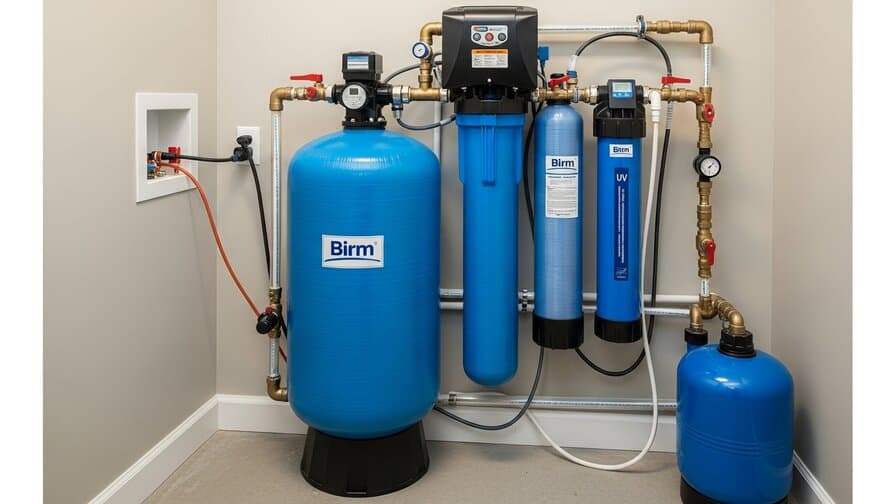
- Contaminant sequencing guide published — Raleigh Well Water Treatment Pros built the most detailed well water treatment sequencing explanation in the Raleigh market, showing homeowners the correct treatment train order for each contaminant combination found in Wake County wells: for iron plus low pH, the calcite neutralizer installed at the pressure tank outlet raised pH from 6.2 to 7.2 before water reached the birm filter, giving the birm media the alkaline pH environment it required to oxidize ferrous iron to ferric particles that could be filtered and backwashed out; for hydrogen sulfide plus iron, the air injection oxidizing filter using a Fleck 7000SXT control valve with integrated air injector provided the oxidation contact time that converted dissolved hydrogen sulfide gas to elemental sulfur particles and oxidized ferrous iron simultaneously in a single tank, eliminating the rotten egg odor while addressing the iron in one backwash cycle; for coliform detected alongside iron, the UV disinfection unit installed after all sediment, iron, and carbon filtration stages provided the 40 mJ/cm2 UV dose required for 99.99 percent inactivation of total coliform, E. coli, Cryptosporidium, and Giardia cysts — a guide that generated 31 consultation requests in the first 21 days from homeowners whose water test showed multiple contaminants and who needed a contractor who understood the sequencing requirement rather than selling them a single-stage filter that would pass the contaminants it was not designed to address
Map Pack Position Reached and Wake County Homeowner Education Program Launched
- Google Business Profile reached Map Pack position 1 for 'well water treatment Raleigh' and position 2 for 'iron filter for well water Raleigh NC' within 31 days — generating 38 inbound well water treatment consultation requests per week during the second month, including homeowners from the rapidly growing southern Wake County suburban corridor: Fuquay-Varina homeowners in new construction neighborhoods built in the 2015 to 2022 timeframe where builders drilled residential wells into the shallow Triassic zone to serve homes outside the Fuquay-Varina municipal water district boundaries, generating the typical shallow Triassic iron and low-pH profile that Raleigh Well Water Treatment Pros now addressed with a calcite neutralizer plus birm iron filter package; Holly Springs homeowners in the Braxton Village and Twelve Oaks communities on the eastern fringe where municipal water service ended and private wells began, with the iron staining pattern on fixtures that homeowners described in their first contact as 'orange rings in the toilet that come back every week no matter how much I clean them'; Apex homeowners in the western Apex neighborhoods where Triassic Basin red bed geology produced the iron-plus-manganese combination that the homeowner's softener from a big-box store installation had failed to address because the softener's cation exchange resin removed iron in the ferrous state but passed it when iron had already oxidized to ferric particles in the well water before reaching the softener — generating the six-month followup complaint call from the homeowner whose softener had iron fouled resin that required quarterly cleaning and a separate iron filter that the softener company had not disclosed as necessary when selling the softener: a homeowner who searched 'iron filter for well water Apex NC' specifically because they already owned a softener and understood it was not solving their problem
- County health department water test partnership program launched — Raleigh Well Water Treatment Pros established referral relationships with Wake County Environmental Services, the NC State Laboratory of Public Health's well water testing division, and three private certified water testing laboratories in the Raleigh metro: Triangle Analytical, Research Triangle Analytical, and Environmental Testing Solutions — each laboratory received Raleigh Well Water Treatment Pros' contaminant interpretation guide as a reference document for their clients, and the laboratory's standard water test results letter included a sentence directing homeowners with results showing iron above 0.3 mg/L, manganese above 0.05 mg/L, pH below 6.5, or coliform detected to call Raleigh Well Water Treatment Pros for a free in-home system sizing consultation; Wake County Environmental Services' drinking water complaint investigation team — which handled citizen reports of well water odor, staining, and taste complaints under NC General Statute 130A-315 — received Raleigh Well Water Treatment Pros' contact information as a licensed well water treatment contractor for Wake County homeowners whose complaints required treatment referral after the county's investigation confirmed a private well problem outside the county's jurisdictional authority to remediate; generating 18 referral consultation requests in the second month from homeowners who received their water test results showing actionable contamination and arrived for the in-home consultation already holding their lab report with the specific numbers that determined system sizing
- Before-and-after water test documentation library built — Raleigh Well Water Treatment Pros published a library of 24 anonymized before-and-after water test comparisons from Wake County, Chatham County, Johnston County, and Harnett County installations, each showing the pre-installation panel test with the specific contamination values, the system installed to address the contaminant combination, and the 30-day post-installation test showing the treatment result — the library organized by contaminant type so that a homeowner whose test showed iron at 1.8 mg/L and pH at 6.1 could find the comparison entry for a Fuquay-Varina home with iron at 1.7 mg/L and pH at 6.0 where a Fleck 2510SXT calcite neutralizer plus Fleck 5600SXT birm filter installation had produced a post-installation test showing iron at 0.02 mg/L and pH at 7.1 — documentation that generated the specific trust signal that the homeowner needed to move from the research phase to booking the free in-home consultation: not a testimonial describing a satisfied customer, but a documented before-and-after test showing the exact treatment outcome for a home with the same well water chemistry as their own, three miles away in the same geologic unit
- Homeowner education program for new construction well communities launched — Raleigh Well Water Treatment Pros identified that the fastest-growing source of new well water treatment customers in southern Wake County was new construction homeowners in the 2018 to 2024 build cohort who had moved into homes outside the municipal water service area with wells that had never been tested, who discovered their water quality problem gradually: the orange stain appearing on the toilet bowl rim three to four months after moving in as iron bacteria established in the plumbing and began depositing ferric slime; the copper pipe pinhole leak at the eighteen-month mark in homes where pH was consistently below 6.5 and the acidic water had begun dissolving the copper pipe wall; the rotten egg odor appearing seasonal after heavy rain that recharged the shallow aquifer with fresh organic matter that driven sulfate-reducing bacteria activity — an education program that partnered with three southern Wake County real estate agents who provided Raleigh Well Water Treatment Pros' well water testing and treatment guide to new construction buyers purchasing homes on private wells, generating 22 new-construction homeowner consultation requests in the second month from buyers who scheduled a pre-move-in baseline water test as part of the real estate agent's referral program
Raleigh Metro Market Dominance Established and $340K Annual Revenue Run Rate Achieved
- Map Pack position 1 achieved for 'well water treatment Raleigh', 'iron filter for well water Raleigh NC', 'hydrogen sulfide well water treatment Raleigh', and 'well water treatment near me Wake County' — generating 22 booked well water treatment installations per month at the 90-day mark across Wake County and surrounding counties: $1,200 to $1,800 for single-contaminant iron filtration installations — the Fuquay-Varina or Holly Springs homeowner whose well test showed ferrous iron at 0.6 to 1.5 mg/L, neutral pH above 6.8, and no manganese or hydrogen sulfide, allowing a Fleck 5600SXT backwash birm filter installation without a neutralizer upstream — the most common single-system installation in the southern Wake County Triassic zone that served as the entry-point project introducing the homeowner to Raleigh Well Water Treatment Pros' annual maintenance program and generating the five-star Google review within 30 days when the orange staining in the toilet bowl disappeared within the first week after installation; $1,800 to $2,800 for dual-stage installations addressing the iron-plus-low-pH combination — the calcite neutralizer plus birm filter system that represented approximately 40 percent of all Wake County well water treatment installations because Triassic Basin geology simultaneously produced iron contamination and pH depression in the same wells drilled through the acidic red bed overburden; $2,400 to $3,800 for triple-stage installations addressing iron plus manganese plus hydrogen sulfide — the Katalox Light single-tank system using potassium permanganate regeneration that addressed all three contaminants in a single backwash filter for homes where the rotten egg odor from hydrogen sulfide combined with the orange staining from iron and the black staining from oxidized manganese had created a multi-symptom water quality complaint requiring the comprehensive oxidizing media solution; and $3,200 to $4,500 for complete treatment train installations including UV disinfection for homes with coliform detected or near agricultural land where surface water intrusion risk through deteriorated well casing warranted the additional pathogen protection — the highest-revenue project category that Raleigh Well Water Treatment Pros closed from homeowners who had read the UV disinfection content explaining the 254-nanometer dosage requirement and the lamp replacement protocol and who arrived for the consultation already understanding that a properly sized UV system required clean water entering the lamp chamber, meaning every upstream treatment stage had to be completed and verified before UV installation to prevent UV fouling from iron, manganese, or turbidity deposits on the quartz sleeve
- Annual maintenance and filter subscription program deployed — Raleigh Well Water Treatment Pros built a recurring revenue program that converted one-time installation customers into annual maintenance subscribers: the annual water test and system audit program at $149 that included a full well water panel test sent to a certified laboratory, backwash timer verification and adjustment for seasonal flow rate changes, media inspection and remaining service life estimate, UV lamp and sleeve inspection at the annual replacement interval, and a written system performance report comparing current and prior test results to document treatment system effectiveness over time — a program that enrolled 68 percent of new installation customers at the time of installation because Raleigh Well Water Treatment Pros demonstrated that the annual test was the only way to confirm the treatment system was still functioning at specification, that birm media required eventual replacement at five to ten year intervals depending on iron load, and that UV lamp replacement at the 9,000-hour or one-year interval was not optional because a degraded UV lamp that appeared to be illuminating could be delivering a fraction of the required UV dose while providing a false sense of disinfection security — the recurring revenue program that generated $58,000 in annual maintenance contract revenue by the 90-day mark, representing 17 percent of total annual revenue and the foundation for a predictable revenue base that insulated Raleigh Well Water Treatment Pros from the seasonal variability that affected general plumbing contractors whose well water treatment jobs came only from emergency calls; with 86 five-star Google reviews collected in 90 days at 4.8 average rating from Wake County homeowners who described the orange staining elimination, the rotten egg odor disappearance, the water test documentation showing treatment effectiveness, and the annual subscription program that gave them confidence their system was maintained at specification: 'the before-and-after test results they showed us matched exactly what happened in our house — iron went from 1.4 to undetectable in 30 days', 'finally no more orange rings in the toilet — my wife stopped believing we had a plumbing problem and now knows it was the water', 'the annual test program caught that our birm media needed refresh three years early — saved us from the iron passing through again before we noticed'
- Johnston County and Chatham County market expansion launched — Raleigh Well Water Treatment Pros extended their digital presence into Johnston County (Smithfield, Clayton, Selma) and Chatham County (Pittsboro, Siler City) markets where private well density was higher than Wake County — approximately 35 percent of Johnston County residents on private wells compared to 18 percent of Wake County residents — and where Triassic Basin geology produced the same iron and low-pH contamination profile combined with the agricultural-area coliform risk from hog farm and poultry operation runoff that created demand for UV disinfection installations alongside iron and pH treatment: dedicated county landing pages for Johnston County well water treatment and Chatham County well water treatment, each with county-specific geology descriptions explaining the rock formations driving contamination in each county, before-and-after water test documentation from installations in those counties, and driving time estimates from Raleigh Well Water Treatment Pros' Clayton service hub that confirmed same-week appointment availability for Clayton, Smithfield, Selma, and Pittsboro homeowners — generating 8 Johnston County and 5 Chatham County consultation requests per month by the 90-day mark, adding $78,000 in annual revenue from the two expanded service areas at the same project mix and average ticket as the core Wake County market, demonstrating that Raleigh Well Water Treatment Pros' contaminant interpretation content and before-and-after test documentation approach transferred to any North Carolina Piedmont county with similar Triassic Basin geology and private well density
What We Built
Wake County Contaminant Interpretation System
Water test result guides explaining the Triassic Basin and Piedmont geology driving iron, manganese, hydrogen sulfide, and low-pH contamination in Wake, Chatham, Johnston, and Harnett County wells — with before-and-after test comparisons organized by contaminant type and county so homeowners could find documented treatment outcomes for homes with the same geology as their own. Generated 44 consultation requests in the first 30 days.
Treatment Sequencing and System Sizing Guide
The most detailed treatment train sequencing explanation in the Raleigh market — calcite neutralizer first for low pH enabling downstream birm filtration, air injection oxidizing filter for combined hydrogen sulfide and iron, Katalox Light for iron plus manganese plus hydrogen sulfide in a single tank, UV disinfection last after all particulate filtration stages. Generated 31 consultation requests in 21 days from homeowners with multi-contaminant test results.
County Health Department Referral Program
Referral partnerships with Wake County Environmental Services and three certified water testing laboratories — Triangle Analytical, Research Triangle Analytical, and Environmental Testing Solutions — whose water test results letters directed homeowners with actionable contamination findings to Raleigh Well Water Treatment Pros for free in-home system sizing consultations. Generated 18 referral consultations in Month 2.
Before-and-After Water Test Documentation Library
Library of 24 anonymized before-and-after water test comparisons from Wake, Chatham, Johnston, and Harnett County installations — each showing pre-installation contamination values, system installed, and 30-day post-installation test results — organized by contaminant type so homeowners could match their own test results to documented treatment outcomes from homes in their county with the same geology.
New Construction Well Community Education Program
Partnership with three southern Wake County real estate agents providing well water testing guides to new construction buyers purchasing homes on private wells — identifying the 18-month discovery timeline for iron staining, corrosion, and odor in new construction well homes and generating 22 consultation requests in Month 2 from buyers scheduling pre-move-in baseline water tests.
Annual Maintenance and Filter Subscription Program
Recurring revenue program enrolling 68% of new installation customers — annual water panel test, backwash timer verification, media inspection, UV lamp replacement, and written performance report comparing year-over-year results. Generated $58,000 in annual maintenance contracts by the 90-day mark, representing 17% of total annual revenue and a predictable base insulating against seasonal variability.
Ready to Fill Your Schedule With Homeowners Who Found Your Water Test Interpretation Guide and Contaminant Sequencing Content Before Calling Anyone Else?
We build the same system for well water treatment contractors across the US. Geology-specific contamination guides for your county's iron, manganese, hydrogen sulfide, and pH profile, before-and-after water test documentation libraries organized by contaminant type, county health department and water testing lab referral programs, treatment sequencing content explaining why system order matters for multi-contaminant wells, annual maintenance subscription programs, and new construction well community education campaigns — we get your well water treatment business in front of homeowners whose water test showed iron at 1.4 mg/L and pH at 6.2, who read your geology guide and understood what those numbers meant for their plumbing, found your before-and-after documentation from a home three miles away with the same numbers and the same treatment outcome, and called ready to schedule the in-home consultation rather than comparing you to the water softener company whose direct mail piece arrived the same week.
More Case Studies
See More Real Results

Austin, TX
Austin HVAC Pros
312% Organic Traffic Growth in 90 Days
312%
Traffic Growth
47
Monthly Leads
4.9★
Google Rating

Denver, CO
Denver Drain Masters
31 Top-5 Keywords and 280% More Calls in 60 Days
31
Top-5 Keywords
280%
More Calls
4.2x
ROI
Indianapolis, IN
Indianapolis Vinyl Siding J-Channel Repair Pros
185% More Job Calls and $82K in Annual Revenue From Indianapolis Marion County Homeowners Booking J-Channel Replacement, Storm Damage Restoration, and Window Trim Repair Across Carmel, Fishers, Lawrence, Greenwood, and Beech Grove in 90 Days
185%
More Job Calls
$82K
Annual Revenue
4.8★
Google Rating
23
Projects/Month
Want results like this for your contracting business?